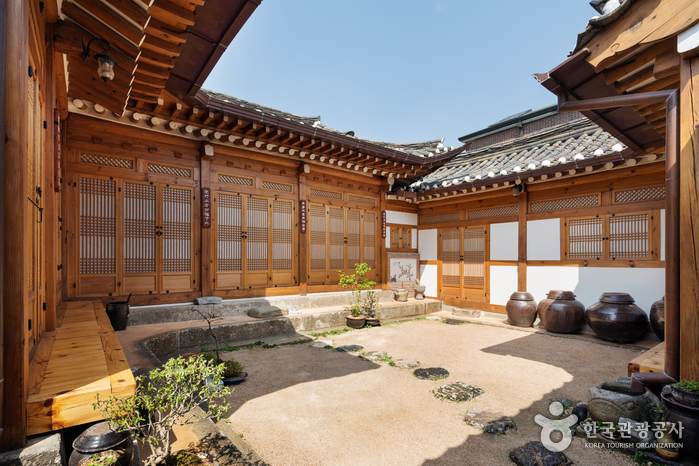
Hanok Guesthouse Dongchonchae / 한옥 게스트하우스 동촌재
14.0Km 2025-08-12
21-10, Jahamun-ro 11-gil, Jongno-gu, Seoul
Built in 1939, Dongchonchae was designated as Seoul Well Hanok by the Seoul Metropolitan City in 2016. In 2020, this hanok (traditional Korean house) received the Certificate of KOREA QUALITY from the Korea Tourism Organization in the Heritage Hanok field in recognition of its historicity and quality of services. Dongchonjae is located in the western side of Gyeongbokgung Palace, at Seochon. When one passes through its main gate, one sees the yard, with anchae (women's quarters), sarangchae (men's quarters), and byeolchae (detached quarters) surrounding the plot. Anchae has four rooms, daecheong (wood-floored main hall), a kitchen, and a restroom. One of the rooms is used for tea ceremonies as well. Outside of the sarangchae and byeolchae, which are the living spaces for the owners, visitors have free access to the numaru (raised open floor) and the yard. The anchae’s rooms “Bom” and “Yeoreum” can accommodate 2 to 3 adults each, while the rooms “Gaeul” (Tea Room) and “Gyeoul” are optimal for two. The building is rented out as a whole, so no more than one group may stay in the building at any given time. Standard occupancy is four persons, and eight is the maximum number. There are two restrooms, one within the anchae building, one out in the backyard.
Cooking is not allowed in the kitchen, but guests are free to bring in outside food. Experience programs on offer include nighttime exploration of Seoul City Wall, tea ceremony, folk songs, and rice cake making. Additional payment is only required for rice cake making. Guests may choose between two types of complimentary breakfast: Korean, which comes with rice, soup, and three side dishes; and Western, which comes with bread, salad, and coffee. There are a 100-in screen and mini projector for film watching in the yard or daecheong. Towels, toiletries, hair dryer, bottled water, traditional tea, and capsule coffee are included. The kitchen is equipped with kitchen utensils, a microwave, and a coffee pot, enough for instant foods. Guests also have access to refrigerator and washing machine
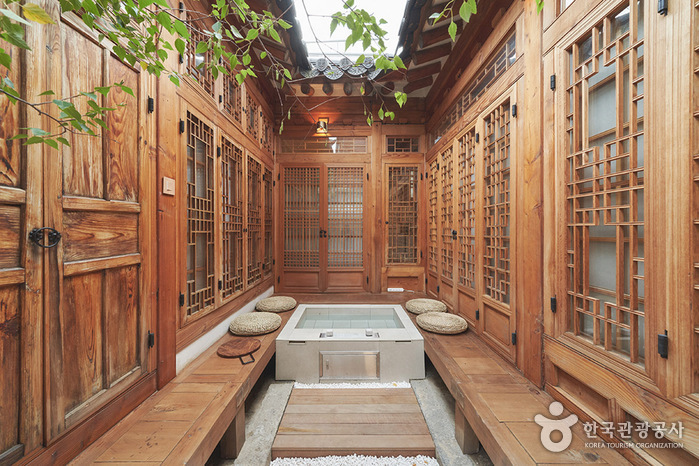
Of one book and stay / 일독일박
14.0Km 2025-08-11
11-1, Pirundae-ro 3-gil, Jongno-gu, Seoul
This hanok (traditional Korean house) is located in Seochon Village near Gyeongbokgung Palace. It is a modern C-shaped hanok centered around the inner courtyard, which is the first thing that the guests see after entering through the gate. While it is not expansive, white pebbles and a foot bath make this hanok a unique one. One can enjoy a foot bath while sitting on the porch.
The bedroom, which is located beyond the living room, is furnished with a queen-sized bed. Opening the screen doors brings one to the view of the kitchen area beyond the inner courtyard. A large table, plush sofa, and a small bookcase make the space ideal for books and discussions. Climbing the wooden ladder to the side of the kitchen brings one to the attic, which also doubles as a Korean-style room with a skylight. The kitchen is furnished with a refrigerator, microwave oven, gas stove, electric kettle, toaster, pots, utensils, wine glasses, and bottled water. There is a restroom with a bathtub. The standard occupancy of the house is 4 people.

Sangchonjae (상촌재)
14.1Km 2023-08-25
12-11 Sangchonjae, Jahamun-ro 17gil, Jongno-gu, Seoul
Sangchonjae House, administré par la Fondation culturelle de Jongno, désigne un espace culturel hanok situé dans le village de Sejong, Ogin-dong, Jongno-gu. Le site propose différentes activités culturelles autour des traditions en Corée.
Université Nationale de Séoul (서울대학교)
14.4Km 2023-07-05
Sillim-dong, Gwanak-gu, Séoul
Fondée en 1946, l’université nationale de Séoul est riche en histoire et en tradition. L’université a été créée autour de l’université Kyongsong par la fusion de plusieurs universités spécialisées publiques et privées. C’est à présent une université pluridiscipinaire qui s’est hissée à la première place des universités publiques du pays. Elle possède un campus à Daehak-dong dans le quartier de Gwanak-gu, et un campus à Yeongeon-dong dans le quartier de Jongno-gu.
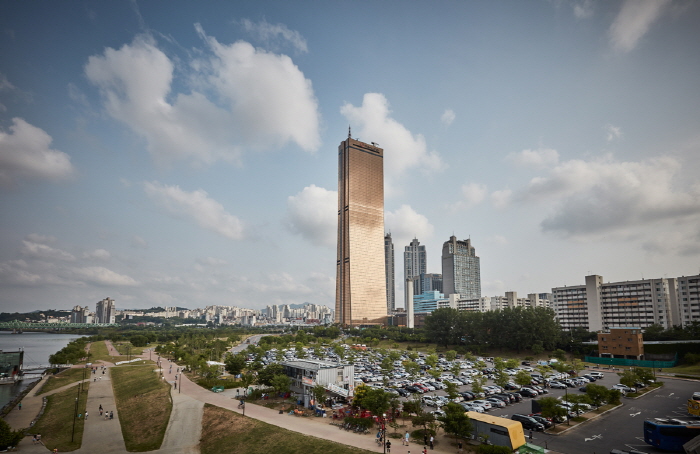
63 Square (63스퀘어)
14.4Km 2022-08-03
50, 63-ro, Yeongdeungpo-gu, Seoul-si
63 Building, le plus haut aux alentours du Fleuve Hangang, est un complexe multi-touristique, avec sa tour d’observation et une variété d’installations pour se divertir. Il est situé tout près du Fleuve Hangang et ses murs en verre dorés qui réflètent, font rougeoyer la région avoisinante dans sa lumière d’or. C’est pour cette raison qu’on l’appelle souvent, la “Tour en Or”.
Ce Bâtiment qui fait 63 étages, a la plus grande tour d’ observation en Corée, et il a également un théâtre IMAX, des restaurants, un centre commercial et un aquarium. La meilleure attraction au 63 Building est probablement sa tour d’ observation. Lorsque vous montez en ascenseur qui est en verre jusqu’à la tour d’observation, vous pouvez voir tous les alentours de la capitale, et les jours clairs, vous pouvez même voir la Mer d’Incheon. Le soir, le Fleuve Hangang, ses ponts très bien éclairés et la circulation des voitures, tout est en harmonie pour créer un panorama spectaculaire. L’aquarium a plus ou moins 400 sortes de vies de mer, 20.000 d’elles au total, qui se font voir dans leurs équipements intérieurs. Depuis les poissons de rivières et de mer, depuis les poissons tropicaux jusqu’aux régions de la jungle ou des régions polaires, toutes sortes de poissons et d’autres créatures de la mer y sont rassemblées.
Le théâtre IMAX a environ la hauteur d’un bâtiment de 6 étages et a des speakers ultra larges et un bon système du son. Il a un programme pour l’interprétation simultanée des langues étrangères pour les visiteurs étrangers. Il y a également des restaurants, un bar, un club santé, un sauna, un bowling, un centre commercial, et divers restaurants de spécialités et autres facilités afin de mettre les touristes plus à l’aise.
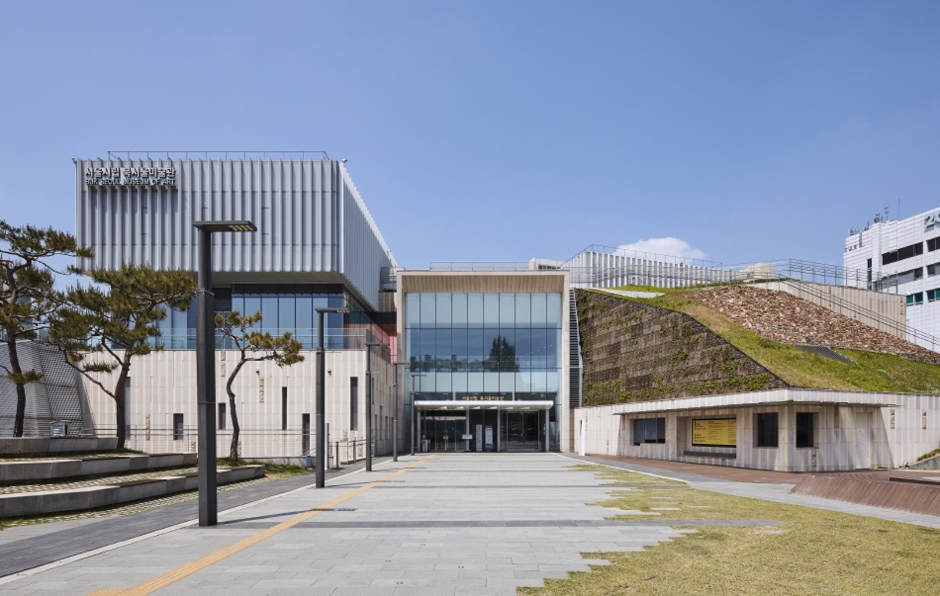
Musée d'art Buk Séoul (서울시립 북서울미술관)
14.6Km 2023-10-17
1238, Dongil-ro, Nowon-gu, Seoul
Le musée d’art Buk Séoul se situe dans le quartier de Junggye-dong (Nowon-gu) et s’étend sur une surface de 17 000 m². Il est composé de trois étages en sous-sol et en hauteur. Le musée propose des expositions permanentes et offre divers programmes d’éducation. Les visiteurs peuvent également prendre pard à des activités culturelles.
 Français
 한국어
한국어 English
 日本語
日本語 中文(简体)
 Deutsch
 Español
 Русский


