
![Olive Young - Sangsu Station Branch [Tax Refund Shop] (올리브영 상수역)](http://tong.visitkorea.or.kr/cms/resource/10/2889110_image2_1.jpg)
Olive Young - Sangsu Station Branch [Tax Refund Shop] (올리브영 상수역)
2.1Km 2024-04-18
Store #101, 1F, 49, Wausan-ro, Mapo-gu, Seoul
-
![Hongdae Chamsinhan Pharmacy [Tax Refund Shop] (홍대참신한약국)](http://tong.visitkorea.or.kr/cms/resource/53/2890653_image2_1.jpg)
Hongdae Chamsinhan Pharmacy [Tax Refund Shop] (홍대참신한약국)
2.1Km 2024-04-23
1F, 62, Eoulmadang-ro, Mapo-gu, Seoul
-
![Sangsangmadang - Hongdae Branch [Tax Refund Shop] (상상마당 홍대)](http://tong.visitkorea.or.kr/cms/resource/97/2887997_image2_1.jpg)
Sangsangmadang - Hongdae Branch [Tax Refund Shop] (상상마당 홍대)
2.1Km 2024-04-22
65, Eoulmadang-ro, Mapo-gu, Seoul
-
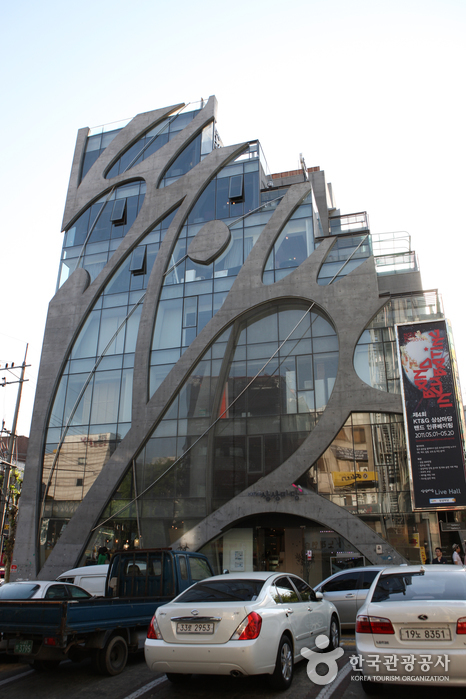
KT&G Sangsangmadang Arts Space (Hongik University) (KT&G 상상마당(홍대))
2.1Km 2024-03-12
65 Eoulmadang-ro, Mapo-gu, Seoul
+82-2-330-6227
KT&G Sangsangmadang Arts Space is a multifaceted cultural space established in 2007. Spanning 660 meters with a total floor area of 3,366 meters, it features facilities such as a theater, a concert hall, a design square, a gallery, and cafés. It offers opportunities for close engagement with culture. Located near Hongik University Station, it boasts excellent accessibility and attracts many visitors due to its diverse attractions.
![Romi Story - Hongdae Branch [Tax Refund Shop] (로미스토리 홍대점)](http://tong.visitkorea.or.kr/cms/resource/57/2890557_image2_1.jpg)
Romi Story - Hongdae Branch [Tax Refund Shop] (로미스토리 홍대점)
2.1Km 2024-04-18
23, Wausan-ro 17-gil, Mapo-gu, Seoul
-
Gyeongui Line Forest Park (Yeontral Park) (경의선숲길(연트럴파크))
2.1Km 2023-08-11
133, Donggyo-ro 51-gil, Mapo-gu, Seoul
Gyeongui Line Forest Park is a linear city park located in Mapo-gu and is also called Yeontral Park. It includes Daeheung-dong, Yeonnam-dong, Saechanggogae Pass, Changjeon-dong, Sinsu-dong, and Wonhyo-ro, which were opened in this order. Gyeongui Line Forest Park is established atop the Gyeongui railroad line and the Gyeongui Line and Airport Railroad Express are constructed as a double track underground. Gyeongui Line Forest Park was designed to be incomplete on purpose to invite the citizens in completing the park. The area which could have been left empty and neglected has turned into a meaningful green park for the citizens by the citizens.
![E-Mart - Mapo Gongdeok Branch [Tax Refund Shop] (이마트 마포공덕)](http://tong.visitkorea.or.kr/cms/resource/21/2888621_image2_1.jpg)
E-Mart - Mapo Gongdeok Branch [Tax Refund Shop] (이마트 마포공덕)
2.2Km 2024-04-22
212, Baekbeom-ro, Mapo-gu, Seoul
-
![Angyeong Gongjang Gongjangjang Contact Lens [Tax Refund Shop] (안경공장공장장콘택트)](http://tong.visitkorea.or.kr/cms/resource/46/2891246_image2_1.jpg)
Angyeong Gongjang Gongjangjang Contact Lens [Tax Refund Shop] (안경공장공장장콘택트)
2.2Km 2024-04-22
83, Dongmak-ro, Mapo-gu, Seoul
-
Seodaemun Independence Park (서대문독립공원)
2.2Km 2022-12-15
251, Tongil-ro, Seodaemun-gu, Seoul
+82-2-3140-8305
Seodaemun Independence Park was built on the former Seoul Detention Camp. It was used to imprison thousands of Korean independence activists until the liberation from the Japanese occupation on August 15, 1945, as well as the political prisoners during the political turmoil in the 1960s. When the prison was moved to Uiwang-si, Gyeonggi-do in November 1987, the area was restored and turned into a memorial park in August 15, 1992 to honor the sacrifices of the martyrs. The park preserves seven prison buildings, an execution ground, underground women’s prison, and the March 1st Movement Monument that has been moved from Tapgol Park in Jongno.
One of the most significant monuments of the Seodaemun Independence Park is Dongnimmun Gate (Independence Gate), which has been designated a Historic Site. Nearby is Dongnipgwan (Independence Hall), originally called Mohwagwan, which was used to greet Chinese envoys during the Joseon dynasty. Today, the hall enshrines 2,327 tablets inscribed with the names of Koreans who died for the cause of national independence. Standing right next to Dongnimmun Gate are the remnants of Yeongeunmun Gate, another Historic Site. Other sights inside the park include the Patriotic Martyr Monument, Declaration of Independence Monument, and Statue of Dr. Seo Jae-pil, who was an independence activist and publisher of Korea’s first independent newspaper. The main highlight of the park is the Seodaemun Prison History Hall, a former prison building that was renovated into a history museum.
 English
 한국어
한국어 日本語
日本語 中文(简体)
 Deutsch
 Français
 Español
 Русский


