
Amnam Park (부산 암남공원)
18.6Km 2023-01-11
185, Amnamgongwon-ro, Seo-gu, Busan
The magnificent cliffs and tree-lined seaside views of Amnam Park bring the harmony of the bluish-green waters and the forested landscape together. Originally a protected area, entrance was not permitted until its opening to the public in 1996, when visitors could first experience the untouched landscape. Now, visitors can fish, explore the observatory, and enjoy the walking path and the elevated bridge. The abundunt pine trees along the walking path make for a pleasant stroll while the path up to the observatory offers great views. If it is fishing that you want, here you can fish on the ocean as well as off the fantastically shaped rocks. There is also a famous road to go for a drive, leading from Songdo Beach to Amnam Park. This drive takes approximately 5 minutes, but it takes about 20 minutes on foot.
Tomb of King Suro (수로왕릉)
18.7Km 2024-01-23
26 Garak-ro 93beon-gil, Gimhae-si, Gyeongsangnam-do
King Suro founded the Garak Kingdom in AD 42 and married Heo Hwang-ok, a princess from the Indian country of Ayuta, in AD 48. He was the founder of the Gimhae Kim family. Heo Yeop, a Yeongnam governor, gave the tomb its current look in the 13th year of the reign of King Seonjo (1580). The tomb compound includes various buildings, including the Sungseonjeon (where the ancestral tablets of King Suro and his queen are kept), Anhyanggak, Jeonsacheong, and Jegigo, as well as stone structures, such as a sindobi (tombstone) and gongjeokbi (monument established to pay homage the deceased). The tombstone in front of the royal tomb was built in the 25th year of the reign of King Injo (1647) of the Joseon dynasty. The name Sungseonjeon was bestowed on the tomb by King Gojong in the 21st year of his reign (1884).
Sureungwon Garden (수릉원)
18.7Km 2024-01-23
35 Bunseong-ro 261beon-gil, Gimhae-si, Gyeongsangnam-do
Sureungwon Garden is a place themed around the meeting between King Suro, the founder of Gaya, and Queen Heo, who was the princess of Ayuta Kingdom, known as India. The name Sureungwon Garden also contains the meaning of an elegant forest where King Suro and Queen Heo walked together. An ecological park measuring 39,600 m2 has been created along a low ridge that connects the Tomb of King Suro, an important cultural heritage of the Gaya period; the Ancient Tombs in Daeseong-dong, the tombs of the Gaya kings; and the Bonghwang-dong Historic Site. It was created by representing the maritime kingdom of Gaya, imagining a pond of the garden where King Suro and Queen Heo used to walk, and planting prickly waterlilies and yellow floating hearts that are believed to have inhabited wetlands in the Gaya period. Trails along the cozy forest and pond make it easy to look around comfortably.
Museum of the ancient tombs in Daseong-dong (대성동고분박물관)
19.1Km 2023-01-02
126, Gayaui-gil, Gimhae-si, Gyeongsangnam-do
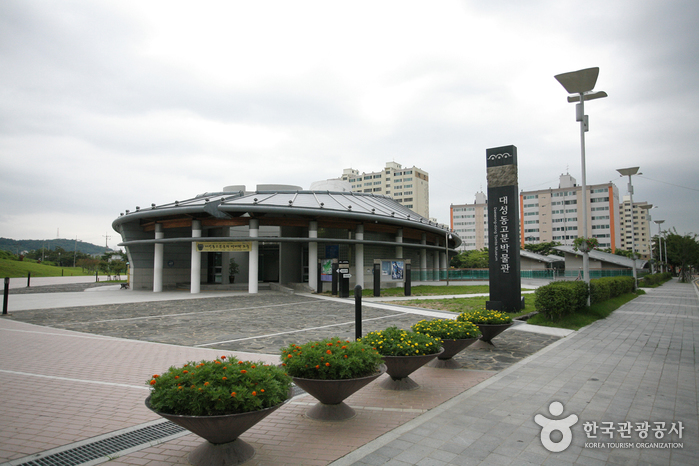
The Museum of the ancient tombs in Daseong-dong displays artifacts unearthed from the four excavations of the Daeseongdong Tumuli. Highlighting often overlooked relics of the Geumgwan Gaya, the museum has three ground-floor exhibit halls and several underground auxiliary facilities. The main exhibits include a life-sized statue of a mounted soldier and a warrior statue, both recreated based on bones excavated from the tumuli of Yean-ri. The museum relies heavily on videos and dioramas to help visitors explore all the museum has to offer.
Gimhae National Museum (국립김해박물관)
19.1Km 2024-01-23
190 Gayaui-gil, Gimhae-si, Gyeongsangnam-do
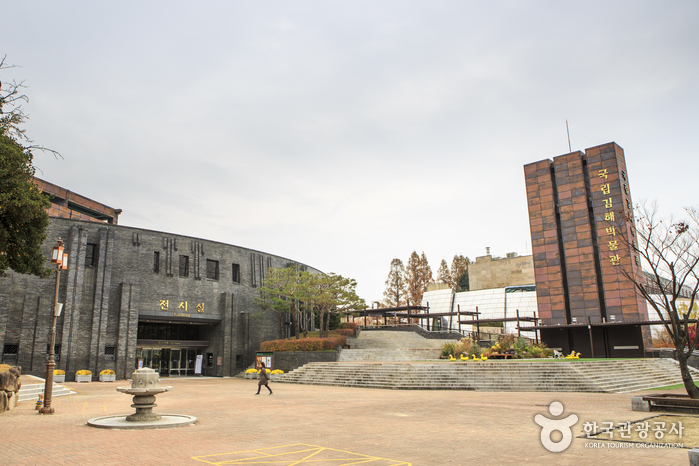
The Gimhae National Museum was opened on July 29, 1998, in order to research and preserve the cultural heritage of the ancient kingdom of Gaya. The museum is at the foot of Gujibong Peak in Gimhae-si, the spot where the kingdom is believed to have been founded. The museum exhibits the cultural assets of Gaya, as well as cultural relics from the prehistoric age in the Busan and Gyeongsangnam-do areas, and the cultural heritage of Byeonhan, which was the foundation for the growth of Gaya.
The exterior of the museum is made using black bricks representing iron ore and charcoal famous during the Gaya Kingdom. There are two exhibition halls, while the walkway to the halls have approximately 1,300 artifacts in display.
Amnam-Park (암남공원)
19.1Km 2025-07-18
Die großartigen Aussichten auf die prächtigen Klippen und die mit Bäumen gesäumte Küste vom Amnam-Park lassen das blau-grüne Wasser mit der bewaldeten Landschaft verschmelzen.
Nach der Erklärung zum Schutzgebiet war der Zutritt zu diesem Gebiet verboten, bis es schließlich 1996 wieder der Öffentlichkeit zugänglich gemacht wurde, und Besucher zum ersten Mal die unberührte Landschaft erleben konnten.
Im Park kann man heute angeln, ein Observatorium besuchen und sich an Spazierwegen und einer erhabenen Brücke erfreuen. Die Fülle an Pinien entlang der Wege machen es zu einem angenehmen Spaziergang; auf dem Weg hinauf zum Observatorium bietet dieses gut beforstete Gebiet großartige Aussichten. Wenn Sie angeln möchten, können Sie dies auf dem Meer oder von den fantastisch geformten Felsen aus tun.
Es gibt eine berühmte Straße vom Songdo-Strand zum Amnam-Park, die beliebt ist für sehr gemütliche Fahrten. Die Fahrt dauert etwa 5 min., wenn Sie zu Fuß gehen wollen, brauchen Sie etwa 20 Minuten.
Gimhae Gujibong Peak (김해 구지봉)
19.4Km 2021-07-13
Gusan-dong, Gimhae-si, Gyeongsangnam-do
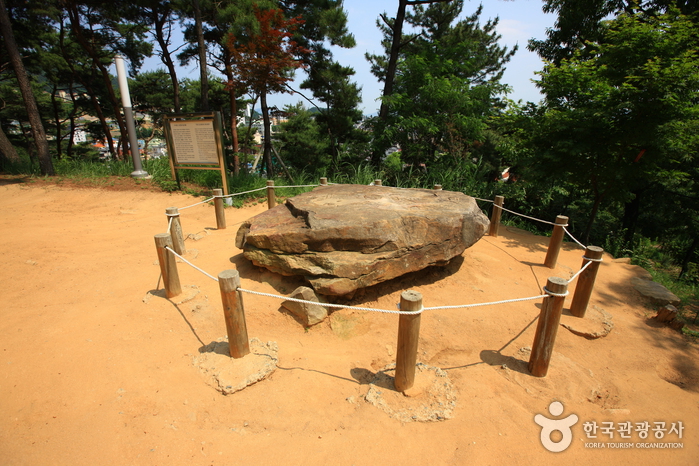
Gujibong Peak in Gusan-dong, Gimhae in Gyeongsangnam-do is believed to be the birthplace of King Suro, the founder of the Gaya kingdom. The peak was originally named Gusubong (“gu” meaning “turtle,” “su” meaning “head”) after its resemblance to the head of a turtle. The flat part of the peak (the turtle’s “head”) is home to the Tomb of King Suro. On the summit is a southern-style dolmen dating back to the 4th century BC that consists of 5 or 6 support stones and a large cover stone measuring 2.5m in diameter. The cover stone bears the inscription “Gujibongseok,” said to be written by Han Ho.
Gujibong Peak is considered a sacred place by the local people because, according to legend, it is the place where the creation of the Gaya Kingdom took place. During the Japanese colonial rule, the “neck” of the turtle was destroyed by the construction of a mountain road. Years later, a pedestrian road was built to rejoin the neck and restore the feng shui of the mountain.
Gimhae Arts and Sports Center (김해문화의전당)
19.5Km 2022-12-29
2060, Gimhae-daero, Gimhae-si, Gyeongsangnam-do
The Gimhae Arts and Sports Center is a performance hall for high-class performances. Maru Hall is a multi-purpose theater that also contains a moving orchestra shell with a sound reflection board for a smaller concert hall inside the theater. Nuri Hall is an experimental theater for performances in a variety of themes. The center also features the outdoor theater Aedureum Madang, Yunseul Art Gallery, Media Center, Sports Center, and Aram Learning Center, as well as a café and restaurants.
Jangnim Port (장림포구)
19.6Km 2023-02-06
72, Jangnim-ro 93beon-gil, Saha-gu, Busan
Jangnim Port is a trending place in Busan that has gained popularity through word of mouth on social media. Administratively, it belongs to Jangnim-dong, Saha-gu, and the name of the port is Jangnim Port after the neighborhood. Because the colorful buildings and small boats floating along the port resemble Venice's Murano Island, its nickname is "Bunezia," meaning Busan's Venice. Due to its beautiful sunset and location on the way to Dadaepo Beach, Jangnim Port has emerged as a new summer resort in Busan, as it is possible to tour in connection with the Amisan Observatory and the Dadaepo Sunset Fountain of Dreams.
Hongnyongsa Temple (Yangsan) (홍룡사(양산))
19.7Km 2025-01-17
372 Hongnyong-ro, Sangbuk-myeon, Yangsan-si, Gyeongsangnam-do
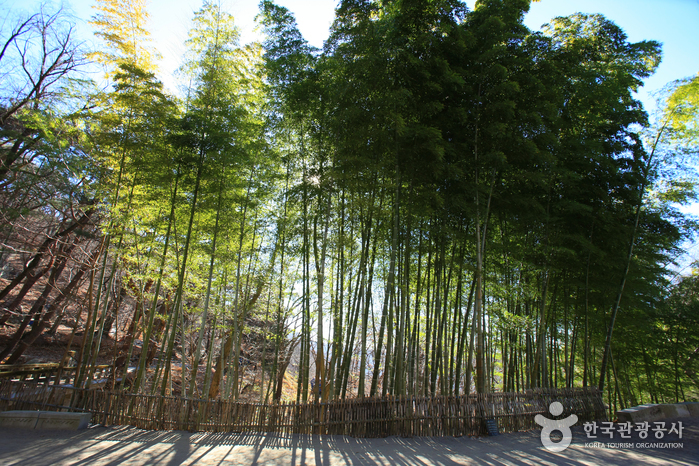
Hongnyongsa Temple, situated on Cheonseongsan Mountain, is renowned for its stunning natural scenery and rich historical traditions. Nearby, Hongnyongpokpo Falls, also known as Mujigaepokpo Falls (Rainbow Falls), captivates tourists with its splendid and invigorating waterfalls. Nestled within lush forests, the temple features a variety of intriguing structures, such as the Gwaneumjeon Hall, the Great Medicine Buddha, and the Sansingak Shrine.
 English
 한국어
한국어 日本語
日本語 中文(简体)
 Deutsch
 Français
 Español
 Русский


