
Namsan Outdoor Botanical Garden (남산 야외식물원)
11.5Km 2022-12-16
323, Sowol-ro, Yongsan-gu, Seoul
Namsan Outdoor Botanical Garden opened its doors on February 18, 1997 in Hannam-dong, where the residential complex for foreigners once stood before it was demolished in 1994. Covering an area of around 59 ㎡, it is divided into 13 themed gardens with a total 117,132 plants from 269 species. Among this diversity, 60,912 plants from 129 species are tree types and 56,220 plants from 140 species are grass types.
Some Sevit (세빛섬)
11.5Km 2022-12-16
2085-14, Olympic-daero, Seocho-gu, Seoul
Some Sevit is a culture complex made up of three man-made floating islands near the southern end of Banpo Bridge. The islands were created with the theme of "flowers of the Hangang River" and represent the view, life, and the earth, as well as a flower in various stages of life. The largest island, 'Some Gavit' symbolizes the view and takes the form of a flower in full bloom. It is a multi-functional cultural facility that can be used as a venue for performances, international conferences, exhibitions, and more. The second island, 'Some Chavit' looks like a flower bud, an image of life. A range of cultural experiences and event zones including Beat Square, Youth Woods, and restaurants using 3D to bring themes to life are located here. The third and smallest island, 'Some Solvit' takes the form of a seed planted in the earth. This island has water sports facilities and an outdoor garden from which you may enjoy the picturesque scenery of the Hangang River. Around the floating islands are LED lights that create a fantastic night view under the theme of "a gleaming light in the mist."
Kervan Turkish Restaurant (케르반레스토랑)
11.5Km 2025-03-15
192 Itaewon-ro, Yongsan-gu, Seoul
Kervan is a Turkish restaurant located in Itaewon, offering authentic kebab, pidé, and Turkish desserts. It faithfully recreates the Turkish culture and food through its interior, decorated with traditional tiles, and dishes prepared by a chef from Türkiye. Main menus include Chicken steak, Rich pidé, and Chicken shish kebab.
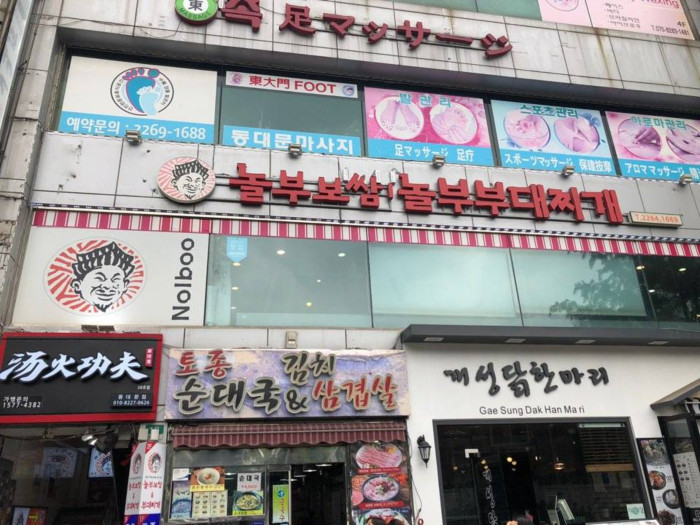
Nolboo Bossam & Budaejjigae Euljiro6ga(놀부보쌈&부대찌개 을지로6가)
11.6Km 2024-10-15
2F, 34, Euljiro43-gil, Jung-gu, Seoul
This is a Korean cuisine located in Dongdaemun Gate, Seoul. One of Korea’s representative restaurant franchises. The best menu at this restaurant is napa wraps with pork.
Seorae Village (서래마을)
11.6Km 2022-12-16
Banpo-dong, Seocho-gu, Seoul
Seorae Village is located in between Banpo 4-dong and Bangbaebon-dong in Seocho-gu, Seoul. Seorae Village took its form as a French neighborhood when French residents moved to the area after Ecole Francaise de Seoul, a school for French residents in Korea, was established here in 1985. According to 2008 census, about half of the total 1,000 French citizens residing in Korea were registered to be living in Seorae Village. The area naturally took shape as a global neighborhood as many international residents settled at Seorae Village much thanks to the strong presence of French residents. In addition to its convenient location near the central district area as well as Gangnam area and Hangang River Park, Seorae Village serves as a pleasant environment space for all.
Many shops and restaurants in Seorae Village are small in size and rather charming, resembling those in Europe. A bakery that makes traditional French baguettes using ingredients directly imported from France can be found here. In recent years, Seorae Village has undergone several changes, gaining much attention as one of the most modern and fanciest regions found in Seoul.
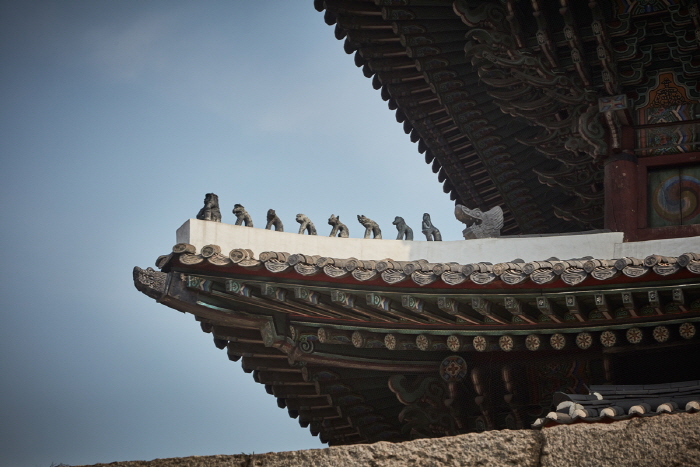
Heunginjimun Gate - Dongdaemun Gate (흥인지문)
11.6Km 2025-10-23
288, Jong-ro, Jongno-gu, Seoul
Heunginjimun Gate was built to protect Hanseongbu, which historically housed essential government facilities. Heunginjimun Gate was the gate on the east side of the outer wall of Seoul Fortress among eight gates. It is referred to as Dongdaemun Gate as well. The gate was constructed during King Taejo’s 5th year in 1396, remodeled during the reign of King Danjong in 1453, and was newly built in 1869 during the sixth year of King Gojong’s reign in 1869.
The gate features a hipped roof with five front and two side compartments on a two-storied building. The thin and weak bracket system supports the eaves and is excessively decorated, reflecting the construction features of the late Joseon period. Also, outside of the fortress is the half-circle-shaped Ongseong, a small wall, to protect the gate.
One of the unique factors of Heunginjimun Gate is that it is the only gate among Seoul’s eight to have Ongseong, further exhibiting the style of construction used during the late Joseon period.
National Theater of Korea (국립극장)
11.6Km 2024-03-06
59, Jangchungdan-ro, Jung-gu, Seoul
The National Theater of Korea opened in 1950 as the first national theater in Asia. It is the only production theater that takes traditional arts to recreate them as contemporary art. It offers various types of theaters, such as Haeoreum Grand Theater, Daloreum Theater (middle-size), Immersive Studio ByeolByeol (small-size), and Haneul Round Theater with a circular stage structure. In addition, the Museum of Performing Arts, Cultural Plaza, and other convenience stores and coffe shops offer pleasure and relax to its visitors.
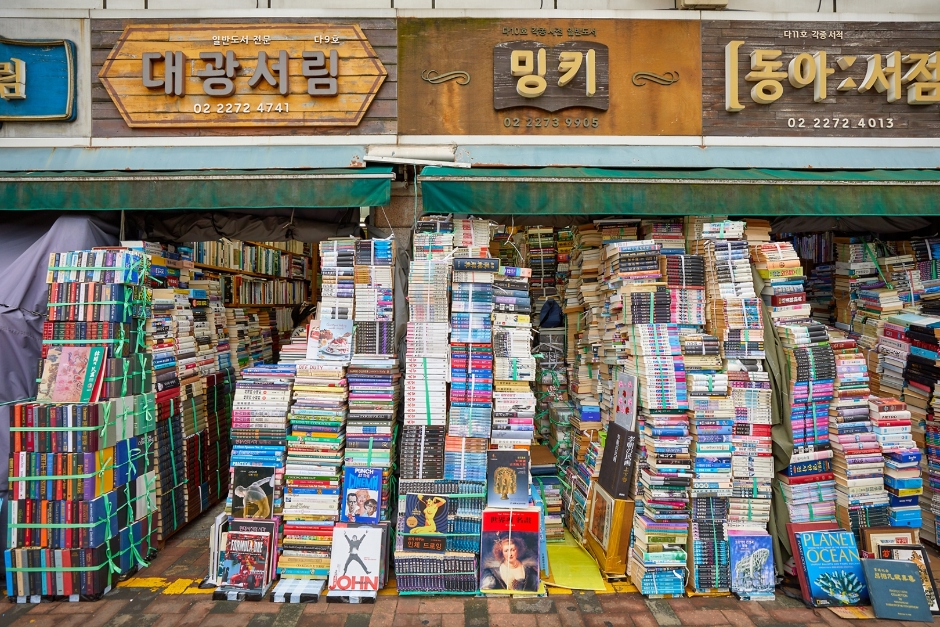
Cheonggyecheon Old Books Street (청계천헌책방거리)
11.6Km 2023-12-22
20 Jangchungdan-ro 13-gil, Jung-gu, Seoul
Walking east along Cheonggyecheon Stream, which flows near Sewoon Plaza, you will see a cluster of small bookstores. Books published 30 to 50 years ago, and various out-of-date magazines are piled up in about ten bookstores. You can indirectly experience the old culture and history that formed the basis of K-content, and sometimes you can also find foreign books. Nearby is Dongdaemun Market, a wholesale market selling various subsidiary materials, and Pyounghwa Market (open from night to early morning), where you can browse clothing fabrics, which are excellent places to visit together.
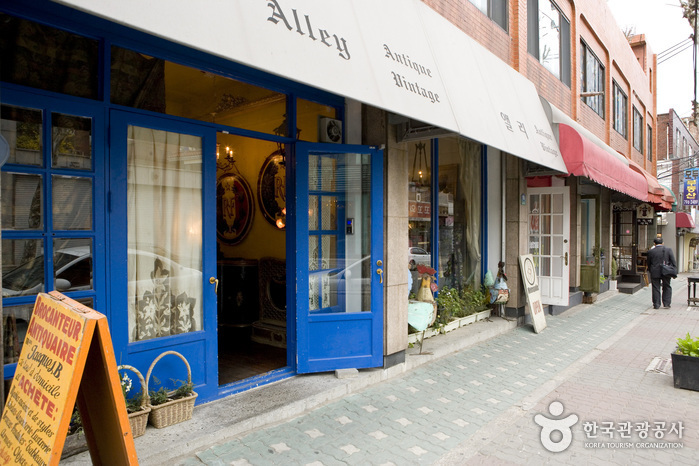
Itaewon Antiques Street (이태원 앤틱 가구 거리)
11.6Km 2025-04-11
109-1 Bogwang-ro, Yongsan-gu, Seoul
Itaewon Antiques Street was formed around the late 1960s, when a group of antique dealerships from Asia, Europe, and North America settled in the district. This 1km-long street is home to antique dealers offering antique sofa, chairs, and tables. Some shops also offer antique decorations, accessories, and clothing. It is a famous shopping district with its own unique ambience from that of Seoul. During spring and autumn, Itaewon Antique Festival takes place, allowing visitors to shop and enjoy cultural performances.
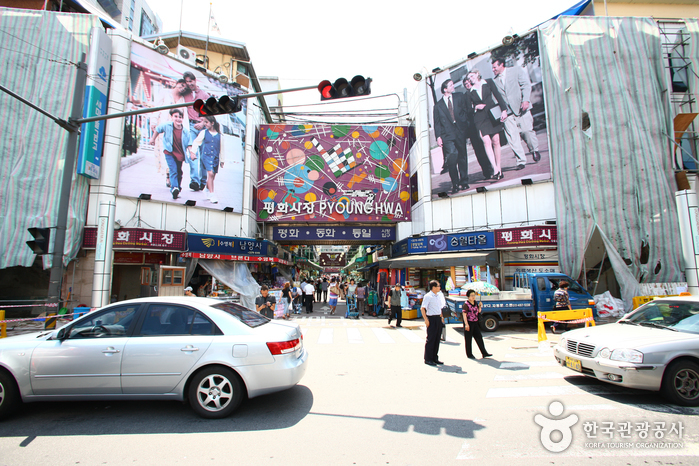
Pyounghwa (Pyeonghwa) Fashion Town (서울 평화시장)
11.6Km 2025-01-06
274, Cheonggyecheon-ro, Jung-gu, Seoul
The Pyounghwa Fashion Town market in Dongdaemun has been selling fashion clothing and accessories for over 50 years ever since the end of the Korean War. It was here that in 1953 North Korean refugees started selling clothes made from US army uniforms. Their market was then named Pyounghwa, which means peace, in the hope that no other wars would be fought on Korean soil. The Pyounghwa Fashion Town was therefore the beginning of the 30,000 stores that now make up Dongdaemun Fashion Town, which is seen as one of the global centers of the fashion industry.
Spread over a large area, this historical fashion market is divided into several districts, the ‘Gu Pyounghwa Fashion Town’ is the oldest, and there is also the ‘Shin Pyounghwa Fashion Town’, ‘Dong Pyounghwa Fashion Town’, and ‘Cheong Pyounghwa Fashion Town’.
 English
 한국어
한국어 日本語
日本語 中文(简体)
 Deutsch
 Français
 Español
 Русский


