![Olive Young - Sinchon Yeonse-ro Branch [Tax Refund Shop] (올리브영 신촌연세)](http://tong.visitkorea.or.kr/cms/resource/83/2888583_image2_1.jpg)
Olive Young - Sinchon Yeonse-ro Branch [Tax Refund Shop] (올리브영 신촌연세)
3.6Km 2024-04-18
37, Yonsei-ro, Seodaemun-gu, Seoul
-
![Stephen Webster - The Shilla Hotel Branch [Tax Refund Shop] (스티븐웹스터 신라호텔)](http://tong.visitkorea.or.kr/cms/resource/50/2888350_image2_1.jpg)
Stephen Webster - The Shilla Hotel Branch [Tax Refund Shop] (스티븐웹스터 신라호텔)
3.6Km 2024-04-17
B1, 249, Dongho-ro, Jung-gu, Seoul
-
![Brioni - The Shilla Hotel Branch [Tax Refund Shop] (브리오니 신라호텔)](http://tong.visitkorea.or.kr/cms/resource/89/2888989_image2_1.jpg)
Brioni - The Shilla Hotel Branch [Tax Refund Shop] (브리오니 신라호텔)
3.6Km 2024-04-23
The Shilla Hotel’s shopping arcade, 249, Dongho-ro, Jung-gu, Seoul
-
![Moynat - The Shilla Hotel Branch [Tax Refund Shop] (모이나 신라호텔)](http://tong.visitkorea.or.kr/cms/resource/73/2889673_image2_1.jpg)
Moynat - The Shilla Hotel Branch [Tax Refund Shop] (모이나 신라호텔)
3.6Km 2024-04-18
1F, 249, Dongho-ro, Jung-gu, Seoul
-
![Hermes - The Shilla Hotel Branch [Tax Refund Shop] (에르메스 신라호텔)](http://tong.visitkorea.or.kr/cms/resource/51/2889751_image2_1.jpg)
Hermes - The Shilla Hotel Branch [Tax Refund Shop] (에르메스 신라호텔)
3.6Km 2024-04-23
249, Dongho-ro, Jung-gu, Seoul
-
![Issey Miyake - The Shilla Hotel Branch [Tax Refund Shop] (이세이미야케 신라호텔)](http://tong.visitkorea.or.kr/cms/resource/54/2890154_image2_1.jpg)
Issey Miyake - The Shilla Hotel Branch [Tax Refund Shop] (이세이미야케 신라호텔)
3.6Km 2024-04-18
249, Dongho-ro, Jung-gu, Seoul
-
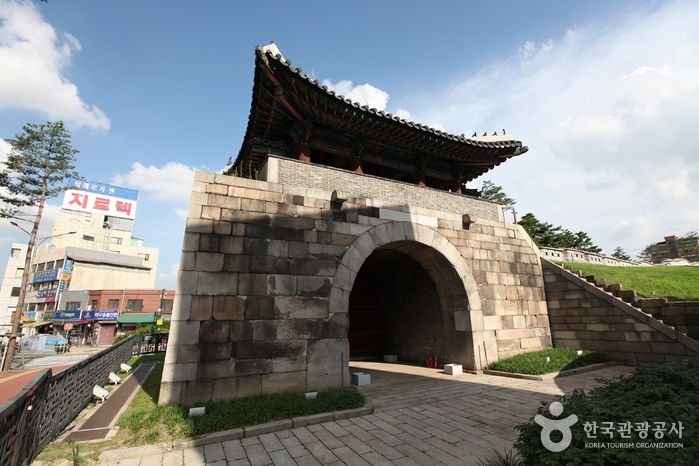
Gwanghuimun Gate (광희문)
3.6Km 2021-02-24
344, Toegye-ro, Jung-gu, Seoul
+82-2-3700-3900
Gwanghuimun Gate is said to have been originally constructed in 1396, the 5th year of King Taejo, at the southeast of the capital city. It was often referred to as Sugumun Gate (water channel gate) and was actually used as a Sigumun, literally meaning “corpse gate,” as funeral processions passed through this gate when exiting to the east.
During the Imjin War (1592-1598), the fortress gate was destroyed to such a degree that it made finding the original location close to impossible. Nevertheless, reconstruction efforts were started in 1711 (37th year of King Sukjong) and the gate was restored together with the gate's watchtower. Gwanghuimun Gate remained intact even when the fortress walls were demolished to build tram tracks during the Japanese occupation, but it was later damaged during the Korean War and left neglected. In 1975, restoration work was carried out to relocate Gwanghuimun Gate to a site 15 meters south of its original location since it stood in the middle of the road.
![ABC-Mart - Sinchon Branch [Tax Refund Shop] (ABC마트 GS신촌점)](http://tong.visitkorea.or.kr/cms/resource/95/2890495_image2_1.jpg)
ABC-Mart - Sinchon Branch [Tax Refund Shop] (ABC마트 GS신촌점)
3.6Km 2024-04-22
6, Myeongmul-gil, Seodaemun-gu, Seoul
-
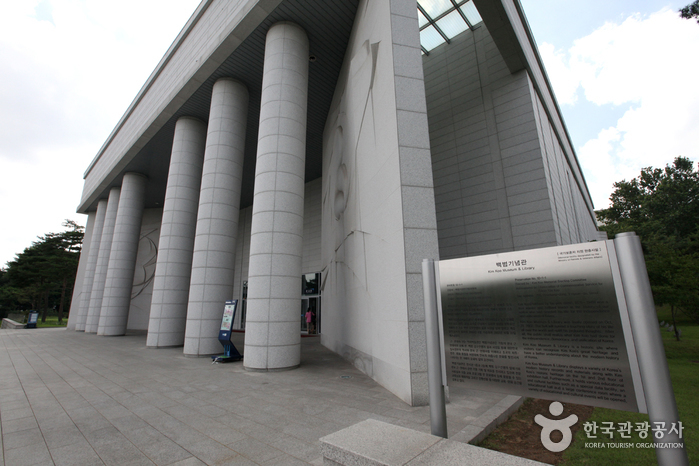
Kim Koo Museum & Library (백범김구기념관)
3.6Km 2022-08-30
26, Imjeong-ro, Yongsan-gu, Seoul
+82-2-799-3400
Kim Koo Museum & Library was built in Yongsan-gu, Seoul to commemorate Baekbeom Kim Koo (1876-1949), a highly respected Korean independence activist. It opened on October 22, 2002 to commemorate Kim Koo's efforts and achievements in Korean history. The main hall is comprised of two floors, exhibiting relics related to his entire life. A statue of a seated Kim Koo is situated in the central space of the first hall.
![Look Optical - Sinchon Branch [Tax Refund Shop] (룩옵티컬 신촌)](http://tong.visitkorea.or.kr/cms/resource/45/2888645_image2_1.jpg)
Look Optical - Sinchon Branch [Tax Refund Shop] (룩옵티컬 신촌)
3.7Km 2024-04-18
1F, 2, Myeongmul-gil, Seodaemun-gu, Seoul
-
 English
 한국어
한국어 日本語
日本語 中文(简体)
 Deutsch
 Français
 Español
 Русский


