
Baek Ni Hyang (백리향)
3.6Km 2024-02-28
57F, 50 63-ro, Yeongdeungpo-gu, Seoul
Baek Ni Hyang is a Chinese restaurant located in Yeouido 63 Square. Combining traditional cooking methods from the Guangdong and Sichuan regions of China with influences from Beijing and Sichuan styles, the restaurant offers Chinese cuisine using seasonal ingredients. The signature dishes include buldojang (Buddha's temptation soup) and dongpayuk (red braised pork belly). The proximity to the Hangang Park and Yeouido Park makes it a great place for a leisurely stroll.
![CheongKwanJang - Jeungsan Station Branch [Tax Refund Shop] (정관장 증산역)](http://tong.visitkorea.or.kr/cms/resource/44/2889544_image2_1.jpg)
CheongKwanJang - Jeungsan Station Branch [Tax Refund Shop] (정관장 증산역)
3.6Km 2024-04-22
#102, 259, Jeungga-ro, Seodaemun-gu, Seoul
-
Youngone Corporation [Tax Refund Shop] (주식회사 영원무역)
3.7Km 2024-04-19
159, Mallijae-ro, Jung-gu, Seoul
-
Ewha Womans University Mokdong Hospital (이화의대부속목동병원)
3.7Km 2025-10-23
1071 Anyangcheon-ro, Yangcheon-gu, Seoul
Ewha Womans University Mokdong Hospital, established in 1993, continues the legacy of Pogoonyogoan (1887), Korea’s first women’s hospital. As a 5th-stage tertiary hospital, it delivers advanced care through specialized centers, treating high-complexity diseases such as cancer, cardiovascular and cerebrovascular disorders, and organ transplantation, as well as chronic conditions like hypertension, diabetes, and joint diseases. With the opening of Cancer Center for Women (2009), Urology Institute (2022), and Blood Cancer Hospital (2025), the hospital has expanded its expertise and patient-centered environment, providing trusted, high-quality medical services.
![E-Mart - Susaek Branch [Tax Refund Shop] (이마트 수색)](http://tong.visitkorea.or.kr/cms/resource/14/2888014_image2_1.jpg)
E-Mart - Susaek Branch [Tax Refund Shop] (이마트 수색)
3.7Km 2024-04-22
217, Susaek-ro, Eunpyeong-gu, Seoul
-
Hangang Paradise (한강파라다이스)
3.7Km 2024-03-25
252 Yeouidong-ro, Yeongdeungpo-gu, Seoul
+82-2-447-3333
Hangang Paradise is a renowned Italian restaurant nestled in Yeouido Hangang Park. It offers a diverse menu featuring items such as steak, pizza, dongaseu (pork cutlet), and bulgogi deopbap (stir-fried bulgogi served with rice), with the tenderloin steak being the standout dish. Guests can savor their meals while enjoying the picturesque views of the Hangang River. Additionally, Hangang Paradise operates a quay for duck boats, adding to its allure as a favored destination for those visiting the Hangang River area.
Seoul Hyochang Park (서울 효창공원)
3.7Km 2024-07-09
177-18 Hyochangwon-ro, Yongsan-gu, Seoul
+82-2-2199-7608
Hyochang Park covers 122,245 square meters spanning across Hyochang-dong and Cheongpa 2-dong. It is a historic landmark that once contained several royal tombs, and was known at that time as Hyochangwon. The cemeteries that were originally located in Hyochangwon belonged to Crown Prince Munhyo, King Jeongjo’s first son who died at the age of five; Royal Noble Consort Uibin of the Seong Clan, King Jeongjo’s royal concubine and Crown Prince Munhyo’s mother; Royal Noble Consort Sugui of the Park Clan, King Sunjo’s royal concubine; and her daughter Princess Yeongon. The royal tombs were moved to Seooreung Tombs in the waning months of the Japanese colonial period. The Japanese empire began the development of Hyochangwon into a park in 1924, and the Japanese governor-general officially assigned the site as a park in 1940.
Presently, several of Korea’s greatest leaders are buried in Hyochang Park. The remains mostly belong to independence activists including Yoon Bong-gil, Lee Bong-chang, and Baek Jeong-gi, whose graves are collectively known as Samuisa Tomb. A statue of Lee Bong-chang has been built in the graveyard. Among the other patriotic martyrs who are interred in the park are Kim Gu and some of the key figures of the provisional government such as Lee Dong-nyeong, Cha I-seok, and Cho Seong-hwan. An ancestral shrine named Uiyeolsa has been built along the main gate and holds the portraits of the deceased independence activists.
Haneul Park (하늘공원)
3.7Km 2024-11-28
95 Haneulgongwon-ro, Mapo-gu, Seoul
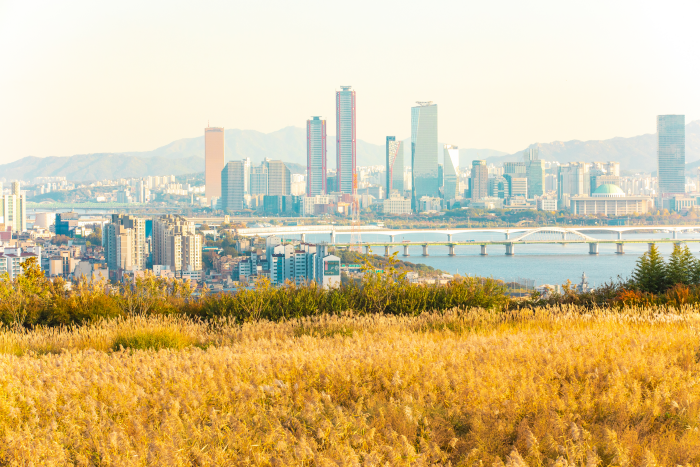
Haneul Park is one of five parks that make up World Cup Park, together with Peace Park, Nanjicheon Park, Nanji Hangang Park, and Noeul Park. It was established for the purpose of restoring the ecological environment so operates its facilities by using natural energy. It features a silver grass field, mixed grassland, rock garden, sunflower field, observatory rest area, and wind power generator. Among the various parts of the World Cup Park, it is located the closest to the sky and shows the transformation from a barren landfill restored to nature. In fall, silver grass forms a spectacle, and, here, visitors can get a clear, panoramic view of Seoul including Bukhansan Mountain and the Hangang River. It is also known as a place for beautiful sunsets and nightscapes.
Seodaemun Prison History Museum (서대문형무소역사관)
3.8Km 2024-12-02
251 Tongil-ro, Seodaemun-gu, Seoul
Seodaemun Prison was built under the Japanese administration to imprison independence movement activists. It first opened on October 21, 1908 under the name Gyeongseong Prison. Eventually, so many activists were imprisoned that the building had to be expanded. At that time, the name changed to Seodaemun Prison on September 3, 1912. Eighty years later, the prison was turned into Seodaemun Independence Park on August 15, 1992 to commemorate the Korean patriots who were tortured in prison, giving their lives for freedom. Of the many buildings, only seven were preserved for their historical significance, among which three prison buildings and the execution site were designated as a Historic Site. In 1998, the park underwent another transformation into today's Seodaemun Prison History Hall to educate the public on the importance of Korea's independence and the sacrifices of those who fought to achieve it.
Yeouido Saetgang Ecological Park (여의도샛강생태공원)
3.8Km 2021-06-14
48, Yeouidong-ro, Yeongdeungpo-gu, Seoul
+82-2-3780-0570
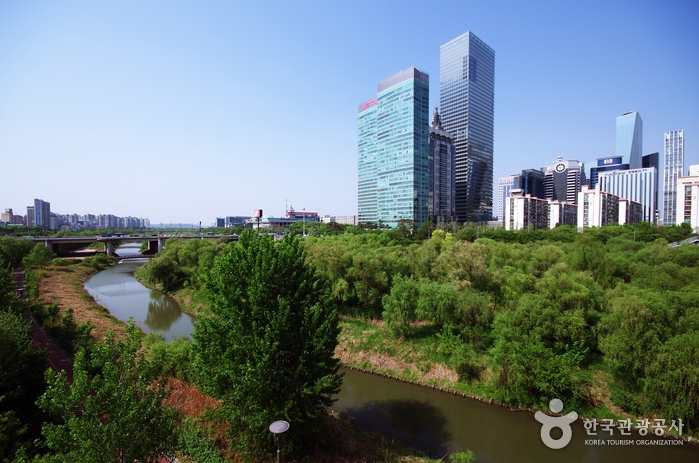
Yeouido Saetgang Ecological Park in central Seoul was the first ecological park in Korea, opened on September 25, 1997. It houses a wide variety of flora and fauna, including kestrels (Natural Monument No. 323), herons, and minnows. There is a 6 kilometer-long promenade that crosses the park, and information signs explaining various flower and plant species throughout the park.
 English
 한국어
한국어 日本語
日本語 中文(简体)
 Deutsch
 Français
 Español
 Русский


