
Seoul Hyochang Park (서울 효창공원)
6.2Km 2024-07-09
177-18 Hyochangwon-ro, Yongsan-gu, Seoul
+82-2-2199-7608
Hyochang Park covers 122,245 square meters spanning across Hyochang-dong and Cheongpa 2-dong. It is a historic landmark that once contained several royal tombs, and was known at that time as Hyochangwon. The cemeteries that were originally located in Hyochangwon belonged to Crown Prince Munhyo, King Jeongjo’s first son who died at the age of five; Royal Noble Consort Uibin of the Seong Clan, King Jeongjo’s royal concubine and Crown Prince Munhyo’s mother; Royal Noble Consort Sugui of the Park Clan, King Sunjo’s royal concubine; and her daughter Princess Yeongon. The royal tombs were moved to Seooreung Tombs in the waning months of the Japanese colonial period. The Japanese empire began the development of Hyochangwon into a park in 1924, and the Japanese governor-general officially assigned the site as a park in 1940.
Presently, several of Korea’s greatest leaders are buried in Hyochang Park. The remains mostly belong to independence activists including Yoon Bong-gil, Lee Bong-chang, and Baek Jeong-gi, whose graves are collectively known as Samuisa Tomb. A statue of Lee Bong-chang has been built in the graveyard. Among the other patriotic martyrs who are interred in the park are Kim Gu and some of the key figures of the provisional government such as Lee Dong-nyeong, Cha I-seok, and Cho Seong-hwan. An ancestral shrine named Uiyeolsa has been built along the main gate and holds the portraits of the deceased independence activists.
![Olive Young - Ahyeon Station Branch [Tax Refund Shop] (올리브영 아현역)](http://tong.visitkorea.or.kr/cms/resource/40/2889240_image2_1.jpg)
Olive Young - Ahyeon Station Branch [Tax Refund Shop] (올리브영 아현역)
6.2Km 2024-04-18
10, Sinchon-ro 35-gil, Seodaemun-gu, Seoul
-
![Mont-Bell - Yongsan Branch [Tax Refund Shop] (몽벨 용산점)](http://tong.visitkorea.or.kr/cms/resource/65/2890565_image2_1.jpg)
Mont-Bell - Yongsan Branch [Tax Refund Shop] (몽벨 용산점)
6.2Km 2024-04-18
92, Hangang-daero, Yongsan-gu, Seoul
-
![ABC-Mart - NC Gangseo Store Branch [Tax Refund Shop] (ABC마트 NC 강서점)](http://tong.visitkorea.or.kr/cms/resource/26/2890326_image2_1.jpg)
ABC-Mart - NC Gangseo Store Branch [Tax Refund Shop] (ABC마트 NC 강서점)
6.3Km 2024-04-18
17, Gangseo-ro 56-gil, Gangseo-gu, Seoul
-
![ER NC Department Store - Gangseo Branch [Tax Refund Shop] (ER NC백화점 강서)](http://tong.visitkorea.or.kr/cms/resource/22/2889622_image2_1.jpg)
ER NC Department Store - Gangseo Branch [Tax Refund Shop] (ER NC백화점 강서)
6.3Km 2024-04-23
17, Gangseo-ro 56-gil, Gangseo-gu, Seoul
-
CheongKwanJang - Doksan Sageori Branch [Tax Refund Shop] (정관장 독산사거리)
6.3Km 2024-04-18
1F, 409, Siheung-daero, Geumcheon-gu, Seoul
-
![Olive Young - Balsan Branch [Tax Refund Shop] (올리브영 발산)](http://tong.visitkorea.or.kr/cms/resource/12/2880112_image2_1.jpg)
Olive Young - Balsan Branch [Tax Refund Shop] (올리브영 발산)
6.3Km 2024-04-22
360, Gangseo-ro, Gangseo-gu, Seoul
-
![E-Mart - Sinwol Branch [Tax Refund Shop] (이마트 신월)](http://tong.visitkorea.or.kr/cms/resource/20/2880120_image2_1.jpg)
E-Mart - Sinwol Branch [Tax Refund Shop] (이마트 신월)
6.3Km 2024-04-22
59, Hwagok-ro, Yangcheon-gu, Seoul
-
![Olive Young - Yongsan Richensia Branch [Tax Refund Shop] (올리브영 용산리첸시아)](http://tong.visitkorea.or.kr/cms/resource/84/2889184_image2_1.jpg)
Olive Young - Yongsan Richensia Branch [Tax Refund Shop] (올리브영 용산리첸시아)
6.3Km 2024-04-22
Store #103, #104, #105, #112, 341, Baekbeom-ro, Yongsan-gu, Seoul
-
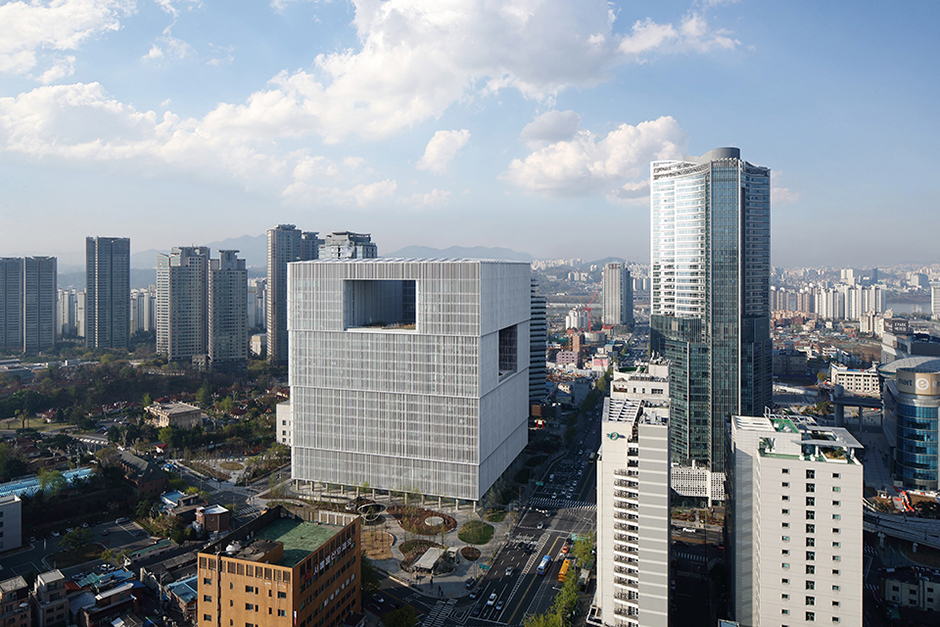
Amorepacific Museum of Art (아모레퍼시픽미술관)
6.3Km 2024-12-31
100 Hangang-daero, Yongsan-gu, Seoul
Amorepacific Museum of Art, located in Yongsan-gu, Seoul, was originally a museum exhibiting artworks collected by the late Seo Seong-hwan, the founder of Amorepacific, but later changed its name to Amorepacific Museum of Art, or APMA, in 2009 and has since been operating as an art exhibition hall. The mission upon its foundation was seeking to be "a space where beauty in the midst of daily lives is discovered" and communicating with the public. In accordance with this objective, the museum collects, researches, and exhibits Korean ancient art and both Korean and international contemporary art while, also, aiding researchers, scholars, and young artists. The underground exhibition hall hosts diverse exhibits encompassing ancient art, contemporary art, and Korean art. The 1st floor of the "Atrium," an enormous space that continues from the 1st to 3rd floors, features the museum lobby, a museum shop, an exhibition space called "APMA Cabinet" and apLAP, which is a library of art exhibition brochures from around the world. The art museum is located on the 1st floor of the new Amorepacific headquarters building, a famous work of architectural beauty of Yongsan designed after white porcelain.
 English
 한국어
한국어 日本語
日本語 中文(简体)
 Deutsch
 Français
 Español
 Русский


