
Olive Young - Wonheung Station Branch [Tax Refund Shop] (올리브영 원흥역점)
9.3Km 2024-06-26
#101, #102, #107, and #108, 668, Gwonyul-daero, Deogyang-gu, Goyang-si, Gyeonggi-do
-
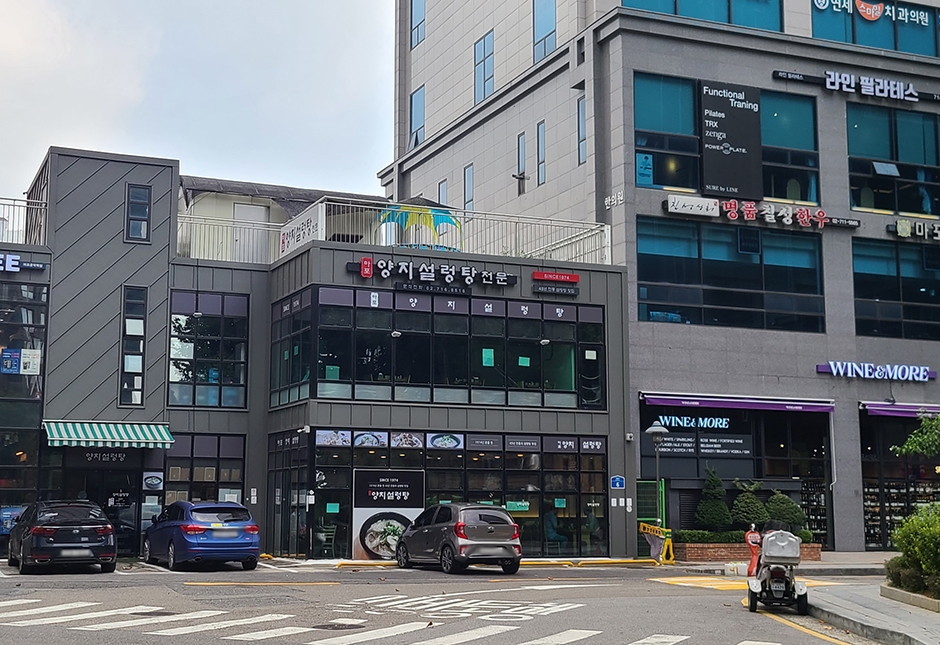
Mapo Yangji Seolleongtang (마포양지설렁탕)
9.3Km 2024-02-22
6 Saechang-ro, Mapo-gu, Seoul
Mapo Yangji Seolleongtang, opened its doors in 1977. The distinctive feature of this seolleongtang (ox bone soup) establishment is its clear broth with minimal meat odor, showcasing the rich flavor of deeply boiled beef bones and the sweetness of beef brisket. Served in a hot pot, it is accompanied by freshly cooked rice and hot soup. In addition to the signature dish, they also offer variations like naejangtang (offal soup), kkoritang (oxtail soup), joktang (ox feet soup) and doganitang (ox knee soup).
Seodaemun Prison History Museum (서대문형무소역사관)
9.3Km 2024-12-02
251 Tongil-ro, Seodaemun-gu, Seoul
Seodaemun Prison was built under the Japanese administration to imprison independence movement activists. It first opened on October 21, 1908 under the name Gyeongseong Prison. Eventually, so many activists were imprisoned that the building had to be expanded. At that time, the name changed to Seodaemun Prison on September 3, 1912. Eighty years later, the prison was turned into Seodaemun Independence Park on August 15, 1992 to commemorate the Korean patriots who were tortured in prison, giving their lives for freedom. Of the many buildings, only seven were preserved for their historical significance, among which three prison buildings and the execution site were designated as a Historic Site. In 1998, the park underwent another transformation into today's Seodaemun Prison History Hall to educate the public on the importance of Korea's independence and the sacrifices of those who fought to achieve it.
Dongnimmun Gate (독립문)
9.3Km 2022-12-15
251, Tongil-ro, Seodaemun-gu, Seoul
Dongnimmun stands at the location originally known as Yeongeun, where envoys were once treated. When a Chinese envoy visited, the King would go out through this door to greet. In 1898, to announce the independence from Japan, Dongnimun was constructed with the fund collected by the citizens. The traces of the past still remain on Dongnimmun with two pillars in front of Dongnimmun being the remains of Yeongeunmun.
The Arc de Triomphe in France can be recalled in comparison to Dongnimmun. Dongnimmun was built using granite with a passageway x_height of 14.28 meters. On the top it is written ‘Dongnimmun’ in Korean with the national flag drawn on each side. On the inner-left side there are stone stairs leading to the attic. The national flower Mugunghwa are planted around Dongnimmun. Now it is surrounded by roads and it is eye-catching to view when passing by.
![Olive Young - Gongdeok Park Palace Branch [Tax Refund Shop] (올리브영 공덕파크팰리스)](http://tong.visitkorea.or.kr/cms/resource/66/2889666_image2_1.jpg)
Olive Young - Gongdeok Park Palace Branch [Tax Refund Shop] (올리브영 공덕파크팰리스)
9.3Km 2024-04-18
1F, 143, Mapo-daero, Mapo-gu, Seoul
-
Seodaemun Independence Park (서대문독립공원)
9.3Km 2022-12-15
251, Tongil-ro, Seodaemun-gu, Seoul
+82-2-3140-8305
Seodaemun Independence Park was built on the former Seoul Detention Camp. It was used to imprison thousands of Korean independence activists until the liberation from the Japanese occupation on August 15, 1945, as well as the political prisoners during the political turmoil in the 1960s. When the prison was moved to Uiwang-si, Gyeonggi-do in November 1987, the area was restored and turned into a memorial park in August 15, 1992 to honor the sacrifices of the martyrs. The park preserves seven prison buildings, an execution ground, underground women’s prison, and the March 1st Movement Monument that has been moved from Tapgol Park in Jongno.
One of the most significant monuments of the Seodaemun Independence Park is Dongnimmun Gate (Independence Gate), which has been designated a Historic Site. Nearby is Dongnipgwan (Independence Hall), originally called Mohwagwan, which was used to greet Chinese envoys during the Joseon dynasty. Today, the hall enshrines 2,327 tablets inscribed with the names of Koreans who died for the cause of national independence. Standing right next to Dongnimmun Gate are the remnants of Yeongeunmun Gate, another Historic Site. Other sights inside the park include the Patriotic Martyr Monument, Declaration of Independence Monument, and Statue of Dr. Seo Jae-pil, who was an independence activist and publisher of Korea’s first independent newspaper. The main highlight of the park is the Seodaemun Prison History Hall, a former prison building that was renovated into a history museum.
![Olive Young - Ahyeon Station Branch [Tax Refund Shop] (올리브영 아현역)](http://tong.visitkorea.or.kr/cms/resource/40/2889240_image2_1.jpg)
Olive Young - Ahyeon Station Branch [Tax Refund Shop] (올리브영 아현역)
9.4Km 2024-04-18
10, Sinchon-ro 35-gil, Seodaemun-gu, Seoul
-
![Aritaum - Guro Yeonjigonji Branch [Tax Refund Shop] (아리따움 구로연지곤지)](http://tong.visitkorea.or.kr/cms/resource/24/2880224_image2_1.jpg)
Aritaum - Guro Yeonjigonji Branch [Tax Refund Shop] (아리따움 구로연지곤지)
9.4Km 2024-04-18
127, Gurodong-ro 26-gil, Guro-gu, Seoul
-
The Catholic University of Korea, Yeouido St. Mary's Hospital (가톨릭대학교 여의도성모병원)
9.4Km 2025-10-23
(Yeouido-dong), 10 63-ro, Yeongdeungpo-gu, Seoul
The Catholic University of Korea, Yeouido St. Mary's Hospital, established in 1936, is a hospital affiliated with a medical school and has a rich history of advancing the country's medical field through exceptional medical staff and pioneering research.
The hospital offers a convenient fast-track service for swift diagnosis and treatment, ranging from complex cancer care to minor conditions. As the first in Korea to open a dedicated lymphoma center, we have specialized expertise in treating various cancers, including lymphoma.
Our use of da Vinci robotic surgery allows for precise, minimally invasive procedures for complex conditions such as uterine fibroids, rectal cancer, prostate cancer, and thyroid cancer, promoting faster recovery. The hospital's one-stop service for breast and thyroid nodules ensures rapid diagnosis and treatment planning, completing biopsies within a single day.
At the Catholic University of Korea, Yeouido St. Mary's Hospital, we remain committed to providing top-tier medical services and advancing medical research while upholding the highest standards of bioethics.
![Nature Republic - Gongdeok Station Branch [Tax Refund Shop] (네이처리퍼블릭 공덕역점)](http://tong.visitkorea.or.kr/cms/resource/92/2878392_image2_1.jpg)
Nature Republic - Gongdeok Station Branch [Tax Refund Shop] (네이처리퍼블릭 공덕역점)
9.4Km 2024-04-22
Store #626-138, B200 Baekbeom-ro, Mapo-gu, Seoul
-
 English
 한국어
한국어 日本語
日本語 中文(简体)
 Deutsch
 Français
 Español
 Русский


