
Yongduam Rock (용두암)
4.5Km 2023-01-13
Yongduam-gil, Jeju-si, Jeju-do
+82-64-740-6000
Situated on the northern coast in downtown Jeju, Yongduam Rock is an estimated 10-meter-tall stone that has been worn down over time by strong winds and waves into a shape resembling a dragon's head. There are many legends surrounding the rock. One legend has it that a dragon stealing precious jade from Hallasan Mountain was shot down by an arrow from the mountain deity. When he fell down, his body immediately sank into the ocean and his head rapidly froze looking at the sky. Another legend has it that a white horse, who dreamed of being a dragon and ascending to the sky, came to be caught by a soldier and froze into the rock.
From Yongduam Rock, visitors can see haenyeo (female divers) working at catching seafood. Near the rock are various cafes, bars, and restaurants. The coastal road between here and Aewol-eup is popular among couples. Cafes and seafood restaurants began to appear there five years ago and now form a pleasant café village.
Yongyeon Pond (용연)
4.6Km 2024-10-24
73 Heungun-gil, Jeju-si, Jeju-do
Yongyeon Pond, located where water from Hallasan Mountain meets the sea, is aptly named "where dragons frolic,”reflecting its stunning vistas and crystal-clear waters. The Yongyeon Cloud Bridge, spanning the area's cliffs, is particularly famous for its breathtaking night views. Additionally, the area becomes a cultural hub every summer with the Yongyeon Floating Musical Concert, an event that recreates the ambiance of late Joseon-era musical performances held on boats, offering a uniqe blend of history and entertainment.
![Angyeong Sarang [Tax Refund Shop] (안경사랑)](http://tong.visitkorea.or.kr/cms/resource/78/2887378_image2_1.jpg)
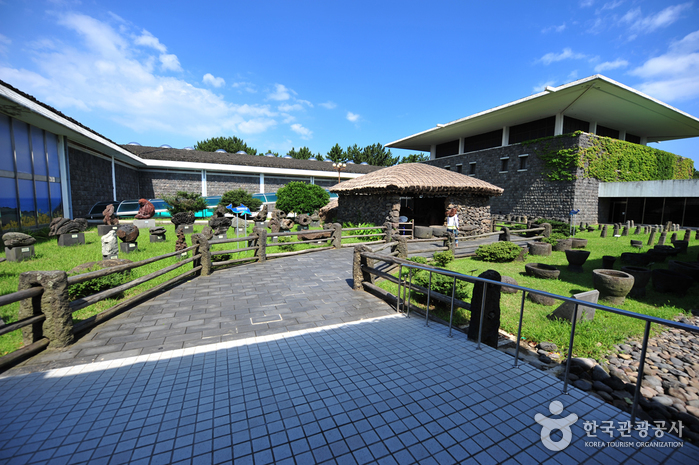
Jeju Folklore & Natural History Museum (제주민속자연사박물관)
4.7Km 2024-03-13
40 Samseong-ro, Jeju-si, Jeju-do
+82-64-710-7708
The Jeju Folklore & Natural History Museum showcases the island's unique traditional culture and natural environment. It features exhibits on Jeju’s natural history, folklore, marine life, and an interactive Jeju Experience Center. Enhancing visitor engamgent, the museum includes dioramas and animated films. A highlight of the Sea Exhibition Hall is the 13m-long skeleton of a Bryde's whale, discovered dead on a jeju beach in 2004.
![Gwandeokjeong Pavillion (Jeju) [관덕정(제주)]](http://tong.visitkorea.or.kr/cms/resource/75/2513575_image2_1.jpg)
Gwandeokjeong Pavillion (Jeju) [관덕정(제주)]
4.7Km 2024-03-15
19 Gwandeok-ro, Jeju-si, Jeju-do
+82-64-740-6000
One of the oldest buildings in Jeju, Gwandeokjeong Pavilion was established in 1448 by the magistrate of Jeju with the purpose of training local soldiers. This historical edifice is renowend for its intricately painted girders, adorned with murals depicting the ten symbols of longevity, scenes from the Battle of Red Cliffs, and hunting imagery. Additionally, the pavilion's signboard is reputed to feature the handwriting of Prince Anpyeong, a notable figure from the Joseon era. Gwandeokjeong Pavillion is part of the Jeju-mok Government Office complex.
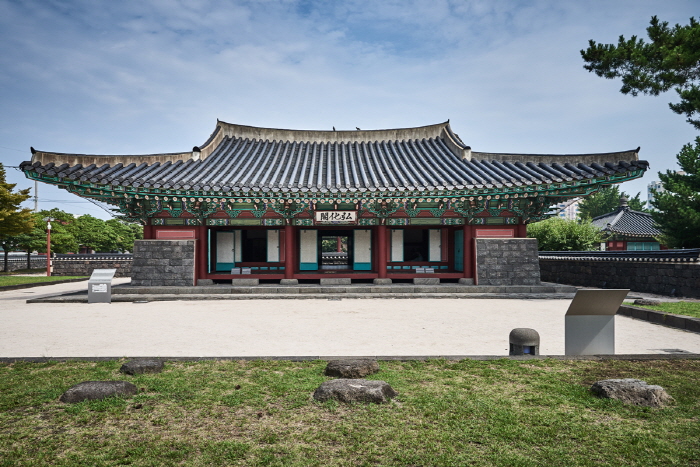
Jeju-mok Government Office (제주목관아)
4.8Km 2024-03-15
25 Gwandeok-ro, Jeju-si, Jeju-do
+82-64-710-6714
The Jeju-mok Government Office was a gwana, or regional government office, that historically served as the center of Jeju Island’s political, administrative, and cultural activities, spanning from its early days as the State of Tamna through the Joseon period. A significant portion of the structure was destroyed in a fire in 1434, leading to subsequent rebuilding efforts. From 1991, archeological excavations were conducted in four stages, enabling the meticulous restoration of several key buildings within the complex. These include the Honghwagak Pavilion, Yeonhuigak Pavilion, Uyeondang Pavilion, Gyullimdang Pavilion, and Gwandeokjeong Pavillion, all of which were restored by December 2002. Additionally, the complex is known for hosting annual nighttime events.
![Samsonite - Jeju Chilseong Branch [Tax Refund Shop] (쌤소나이트 제주칠성)](http://tong.visitkorea.or.kr/cms/resource/80/2889480_image2_1.jpg)
Samsonite - Jeju Chilseong Branch [Tax Refund Shop] (쌤소나이트 제주칠성)
4.8Km 2024-04-18
#1, 67, Jungang-ro, Jeju-si, Jeju-do
-
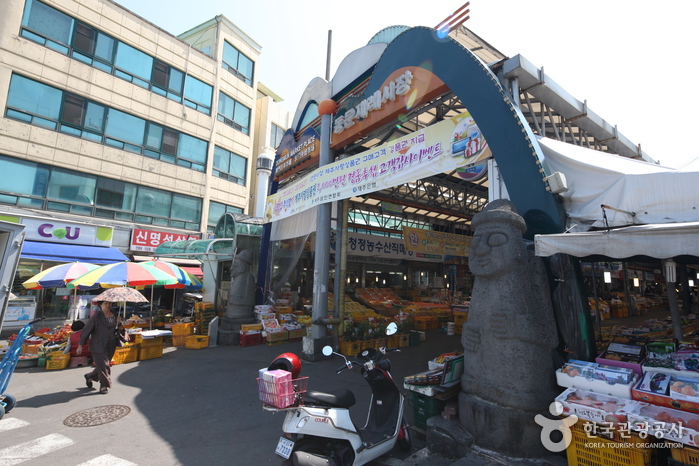
Dongmun Traditional Market (동문재래시장)
4.8Km 2025-04-01
20 Gwandeok-ro 14-gil, Jeju-si, Jeju-do
Dongmun Traditional Market, steeped in history, stands a quintessential market of Jeju Island. Together with the adjacent Dongmun Traditional Fish Market, it forms the core of Jeju’s most significant and expansive permanent market, established right after Korea’s liberation in August 1945. Originally the island’s only permanent marketplace and a hub for its commercial activities, the market was relocated to its present site after a devastating fire in March 1954. It offers an array of goods such as vegetables, fruits, seafood, medicinal herbs, grains, and clothing. Known for its fresh catch, the market is a go-to place for seafood lovers, offering delicacies like sliced raw cutlassfish at reasonable prices. It’s also gaining popularity for its innovative dishes, including samhap (skate, pork, and kimchi combo) served with rice and abalone intestines, as well as tteokgalbi (grilled galbi patties) accompanied by whole abalone.
![Glass Story & Lens Story - Jungang-ro Branch [Tax Refund Shop] (글라스스토리&렌즈스토리중앙로점)](http://tong.visitkorea.or.kr/cms/resource/97/2887397_image2_1.jpg)
Glass Story & Lens Story - Jungang-ro Branch [Tax Refund Shop] (글라스스토리&렌즈스토리중앙로점)
4.8Km 2024-06-27
63, Jungang-ro, Jeju-si, Jeju-do
-
![Selden [Tax Refund Shop] (셀덴)](http://tong.visitkorea.or.kr/cms/resource/71/2887371_image2_1.jpg)
 English
 한국어
한국어 日本語
日本語 中文(简体)
 Deutsch
 Français
 Español
 Русский


