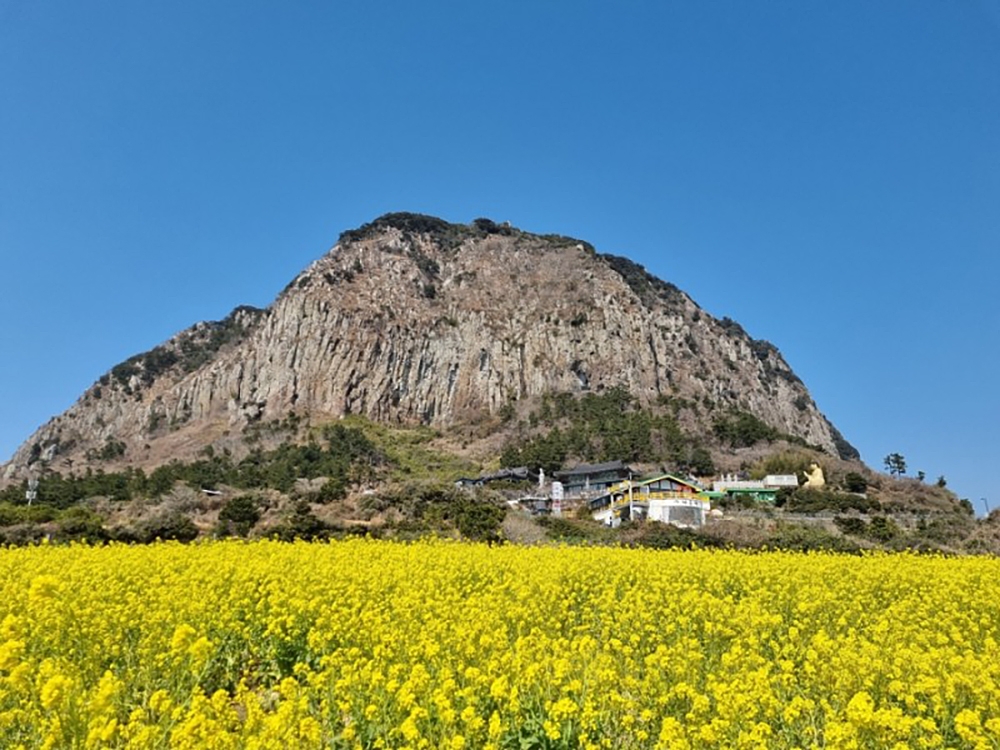
Sanbangsan Canola Field (산방산유채꽃밭)
19.4Km 2024-03-07
San18 Sagye-ri, Andeok-myeon, Seogwipo-si, Jeju-do
The Sanbangsan Canola Field is located next to the public parking lot in front of Sanbangsan Land, making it very easy to find. The vast fields create a beautiful landscape of yellow blossoms before the backdrop of Sanbangsan Mountain. The flowers are usually at peak bloom in March. In addition to Sanbangsan Mountain, other nearby attractions include Yongmeorihaean Coast, and Sagyehaean Coast.

Gwakji Beach (Gwakji Gwamulhaebyeon Beach) (곽지해수욕장 (곽지과물해변))
19.6Km 2023-02-16
Geumseong 5-gil, Jeju-si, Jeju-do
+82-64-728-3985
Gwakji Beach is a beach that has nice conditions including a 350-meter-long, 70-meter-wide white sand beach, an average water depth of 1.5 meters and a slope of about 5 to 8 degrees. Thanks to these conditions, a youth training facility was installed and groups of tourists visit here every year. Gwakji-ri is a historic village where shell mounds from prehistoric times were once excavated. According to a local legend, Gwakji Beach used to be a village in the ancient days, but one day, it became buried in the sand.
![Gwandeokjeong Pavillion (Jeju) [관덕정(제주)]](http://tong.visitkorea.or.kr/cms/resource/75/2513575_image2_1.jpg)
Gwandeokjeong Pavillion (Jeju) [관덕정(제주)]
19.6Km 2024-03-15
19 Gwandeok-ro, Jeju-si, Jeju-do
+82-64-740-6000
One of the oldest buildings in Jeju, Gwandeokjeong Pavilion was established in 1448 by the magistrate of Jeju with the purpose of training local soldiers. This historical edifice is renowend for its intricately painted girders, adorned with murals depicting the ten symbols of longevity, scenes from the Battle of Red Cliffs, and hunting imagery. Additionally, the pavilion's signboard is reputed to feature the handwriting of Prince Anpyeong, a notable figure from the Joseon era. Gwandeokjeong Pavillion is part of the Jeju-mok Government Office complex.
![PAT - Jeju Jisang Branch [Tax Refund Shop] (PAT제주지상점)](http://tong.visitkorea.or.kr/cms/resource/86/2887386_image2_1.jpg)
PAT - Jeju Jisang Branch [Tax Refund Shop] (PAT제주지상점)
19.6Km 2024-04-16
56, Gwandeok-ro, Jeju-si, Jeju-do
-
![Gwangmyeongdang Eyewear [Tax Refund Shop] (광명당안경원)](http://tong.visitkorea.or.kr/cms/resource/04/2887404_image2_1.jpg)
Gwangmyeongdang Eyewear [Tax Refund Shop] (광명당안경원)
19.6Km 2024-04-19
60, Gwandeok-ro, Jeju-si, Jeju-do
-
![All For You [Tax Refund Shop] (올포유)](http://tong.visitkorea.or.kr/cms/resource/04/3314804_image2_1.jpg)
![Clride - Jeju Underground Branch [Tax Refund Shop] (클라이드 제주지하)](http://tong.visitkorea.or.kr/cms/resource/58/2887358_image2_1.jpg)
Clride - Jeju Underground Branch [Tax Refund Shop] (클라이드 제주지하)
19.6Km 2024-04-18
#203, B60 Jungang-ro, Jeju-si, Jeju-do
-
![Skinfood - Jeju Underground Branch [Tax Refund Shop] (스킨푸드 제주지하)](http://tong.visitkorea.or.kr/cms/resource/81/2889581_image2_1.jpg)
Skinfood - Jeju Underground Branch [Tax Refund Shop] (스킨푸드 제주지하)
19.6Km 2024-04-22
#138, #139, and #75, B60 Jungang-ro, Jeju-si, Jeju-do
-
![Ohoo - Jeju Underground Branch [Tax Refund Shop] (오후 제주지하)](http://tong.visitkorea.or.kr/cms/resource/00/2889500_image2_1.jpg)
Ohoo - Jeju Underground Branch [Tax Refund Shop] (오후 제주지하)
19.6Km 2024-04-19
Store #265, 266, B60 Jungang-ro, Jeju-si, Jeju-do
-
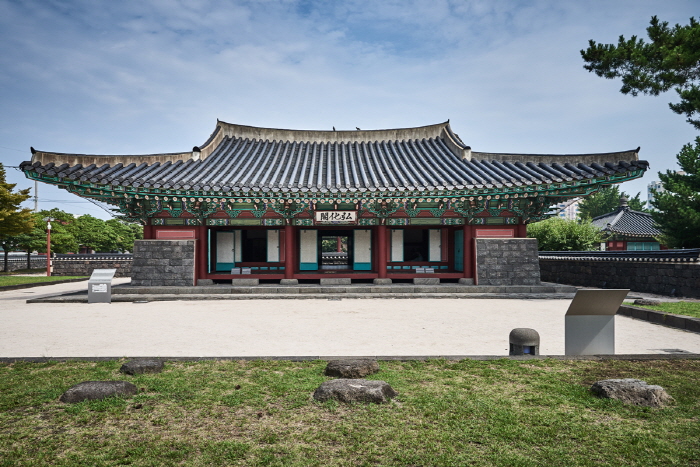
Jeju-mok Government Office (제주목관아)
19.6Km 2024-03-15
25 Gwandeok-ro, Jeju-si, Jeju-do
+82-64-710-6714
The Jeju-mok Government Office was a gwana, or regional government office, that historically served as the center of Jeju Island’s political, administrative, and cultural activities, spanning from its early days as the State of Tamna through the Joseon period. A significant portion of the structure was destroyed in a fire in 1434, leading to subsequent rebuilding efforts. From 1991, archeological excavations were conducted in four stages, enabling the meticulous restoration of several key buildings within the complex. These include the Honghwagak Pavilion, Yeonhuigak Pavilion, Uyeondang Pavilion, Gyullimdang Pavilion, and Gwandeokjeong Pavillion, all of which were restored by December 2002. Additionally, the complex is known for hosting annual nighttime events.
 English
 한국어
한국어 日本語
日本語 中文(简体)
 Deutsch
 Français
 Español
 Русский


