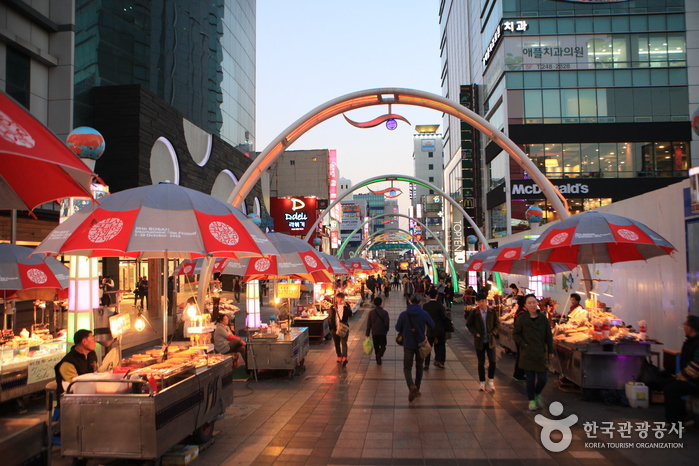
BIFF Square (BIFF 광장)
630.4M 2025-10-23
4 Nampo-gil, Jung-gu, Busan
+82-1688-3010
Busan’s modern movie district was originally little more than a pair of cinemas that were built following Korea’s liberation from Japanese colonial rule over half a century ago. However, major renovations took place ahead of the first Busan International Film Festival (BIFF), and the newly transformed district was named BIFF Square on September 13, 1996.
Having been remade into a cultural tourist attraction promoting the advancement of Korea’s film industry, BIFF Square has contributed to Busan’s status as an international cultural tourist city. The 428 meter-long street stretching from the Buyeong Theater in Nampo-dong to the overpass in Chungmu-dong was divided into “Star Street” and “Festival Street,” and on the eve of the festival each year the “BIFF Square Ground Opening” is held here. During the ceremony, events such as the hand printing of famous movie celebrities and Nunkkot Jeomdeung (snow-flower lighting) take place. A district such as BIFF Square, crowded with first-run theaters in a city is rare not only in Asia but Europe as well, and for this reason it holds great potential. In recent years, the square has grown into a more complex area, featuring not only movie theaters but also shops and leisure facilities, attracting growing numbers of young visitors and tourists.

Yongdusan Jagalchi Special Tourist Zone (용두산 자갈치 관광특구)
643.9M 2021-03-11
52, Jagalchihaean-ro, Jung-gu, Busan
+82-51-600-4000
Yongdusan Jagalchi Special Tourist Zone is an attractive tourism area embracing history and culture. Vendors in the traditional market welcome tourists with their warm hearts, selling their famous street food such as rice cake, ssiat hotteok (sugar-filled seeded griddlecake), bibim dangmyeon (spicy glass noodles), pat juk (red bean porridge), and pat bingsu (shaved ice with sweetened red beans). Bosu-dong and 40-Step Culture & Tourism Themed Street also show the history of each street to people traveling in the area. Including Yongdusan Park, the special tourist zone includes traditional markets like Jagalchi Market, Gukje Market, and Bupyeong Market, and historical cultural resources like Yeongdodaegyo Bridge, Bosu Book Street, and Busan Modern History Museum. The restoration of Yeongdodaegyo Bridge in November 2013 has created a unique sightseeing attraction that is hard to see in other regions and has emerged as a new famous spot. Bupyeong (Kkongtong) Market and Gukje Market are also special markets full of things to see. Various festivals including Busan International Film Festival, Busan Jagalchi Festival, and Busan Christmas Tree Festival are held for all kinds of visitors. The view from Yongdusan Park and fresh seafood from Jagalchi Market, as well as peaceful strolling at Bosu Book Street and 40-Steps make a trip to Busan memorable and happy.
Current State of Yongdusan and Jagalchi Special Tourist Zone
1) Districts Covered: Areas around Gwangbok, Nampo and Bupyeong-dong, parts of Donggwang, Daecheong, Bosu and Jungang-dong, Busan
2) Total Area: 1,079,836 ㎡
3) Designated on May 14, 2008
* Tourist Attractions
Yongdusan Park, Yeongdodaegyo Bridge, Jagalchi Market, Gukje Market, Bupyeong Market, Bosu Book Street, etc.
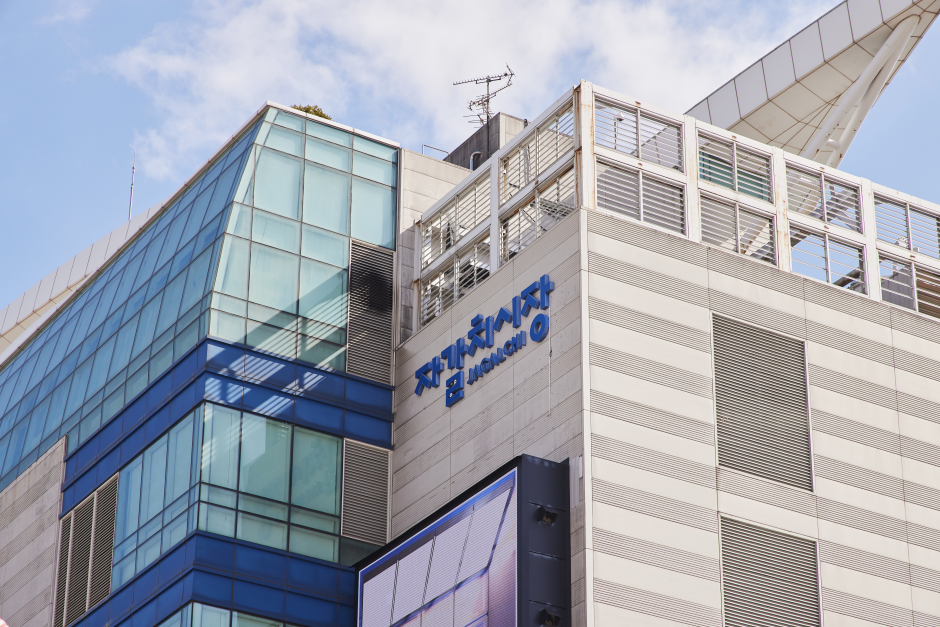
Jagalchi Market (부산 자갈치시장)
644.7M 2025-04-15
52 Jagalchihaean-ro, Jung-gu, Busan
+82-51-245-2594
Jagalchi Market, located on the seaside road in Busan's Jung-gu, is one of the largest seafood markets in Korea, selling both live and dried fish. After the Korean War, the market solidified itself as a fish market. Most of the people who sell fish are women, so the vendors here are called Jagalchi Ajumeoni, "ajumeoni" meaning middle-aged or married woman in Korean.
This market represents Busan and is famous throughout the country. Visitors can eat fresh raw fish right at the market. Even nowadays visitors can see women selling mackerel, sea squirts (ascidians) and other seafood on wooden boxes along the road outside of the market and along the shore.
Gukje Market (국제시장)
668.9M 2025-10-23
Area of Sinchang-ro 4-ga, Jung-gu, Busan
+82-51-245-7389
The current marketplace of Gukje Market first formed after the liberation of Korea from the Japanese administration when people gathered to trade overseas products left by the Japanese and brought in by Koreans who came back from abroad. Following the Korean War, refugees who fled to Busan set up stalls in order to make a living by selling smuggled or imported products, which developed into Gukje Market (gukje meaning "international" in Korean) of today. Gukje Market is one of Korea’s largest markets and a testament to Korea's modern history. The market is divided into two wings, and first-timers to the market are advised to be careful not to get lost in the maze-like alleys and halls.
![Olive Young - Gwangbok Main Branch [Tax Refund Shop] (올리브영 광복본점)](http://tong.visitkorea.or.kr/cms/resource/45/2885845_image2_1.jpg)
Olive Young - Gwangbok Main Branch [Tax Refund Shop] (올리브영 광복본점)
672.4M 2024-04-22
1F, 36, BIFF gwangjang-ro, Jung-gu, Busan
-
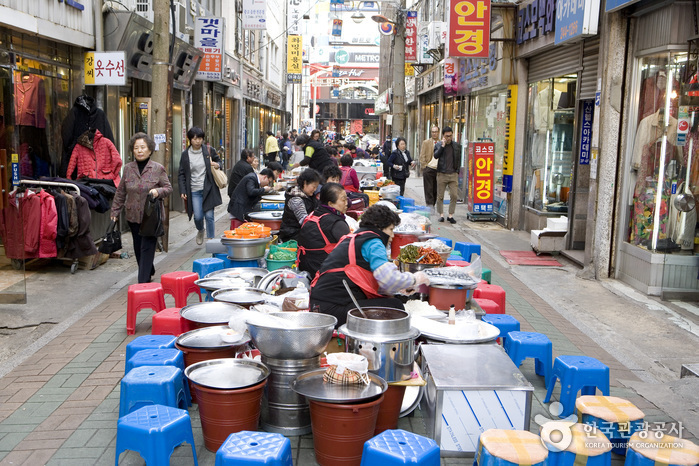
Gukje Market Food Street (국제시장 먹자골목)
705.2M 2024-03-06
36, Junggu-ro, Jung-gu, Busan
+82-51-245-7389
Gukje Market Food Street has more than 60 years of history as one of Busan's traditional markets' most famous food streets. It is known for a number of dishes, such as Chungmu gimbap served with sweet and sour squid salad, sweet-and-spicy tteokbokki, milmyeon (wheat noodles), dwaeji gukbap (pork and rice soup), sundae, patbingsu (shaved ice with red beans), and Busan’s iconic bibim dangmyeon (spicy glass noodles). These dishes are enjoyed on small stools next to the street stalls. The sight of the diners lining the stall is one of the defining views of traditional markets in Korea. Visitors can also find suitable clothing, shoes, and accessories here.
![Ai Hasi - Busan Gukje Market Branch [Tax Refund Shop] (아이하시 부산국제시장)](http://tong.visitkorea.or.kr/cms/resource/11/2889711_image2_1.jpg)
Ai Hasi - Busan Gukje Market Branch [Tax Refund Shop] (아이하시 부산국제시장)
710.9M 2024-04-18
1F, Bldg. A of Ihasi, 33, Gukjesijang 2-gil, Jung-gu, Busan
-
![Artbox - Busan Gwangbok Branch [Tax Refund Shop] (아트박스 부산광복)](http://tong.visitkorea.or.kr/cms/resource/70/2885870_image2_1.jpg)
Artbox - Busan Gwangbok Branch [Tax Refund Shop] (아트박스 부산광복)
721.8M 2024-04-23
28, BIFF gwangjang-ro, Jung-gu, Busan
-
Yeongdodaegyo Bridge (영도대교)
722.4M 2023-04-22
46, Taejong-ro, Yeongdo-gu, Busan
+82-1670-8114
Yeongdodaegyo Bridge, connecting Nampo-dong and Yeongdo Island, was the first bridge to connect the mainland to one of the nearby islands in Busan. The bridge lifted to allow ships to pass between the south and north ports, and made a passage for ships anywhere from two to seven times in one day. When the bridge was first constructed, many people would gather to watch the strange spectacle of a bridge rising up to point to the sky. The bridge remains a famous landmark of Busan even to this day.
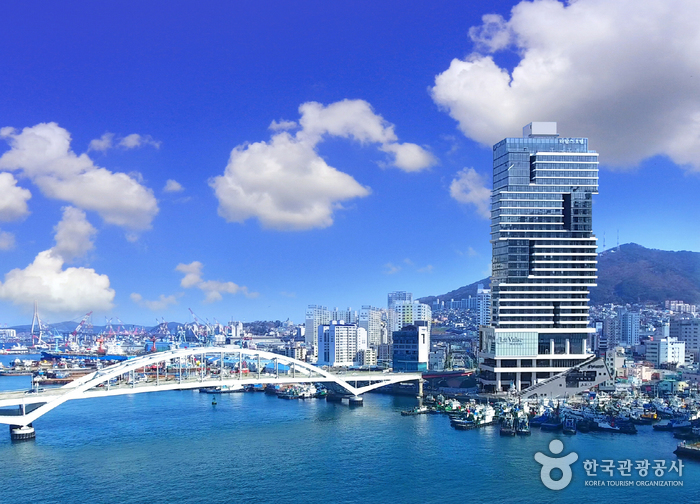
La Valse Hotel Busan (라발스호텔)
724.8M 2024-12-22
82 , Bongnaenaru-ro, Yeongdo-gu, Busan
+82-51-790-1500
The 29 storey La Valse Hotel in Yeongdo-gu, Busan, offers a variety of rooms, most of which have a fine view of the Sea. The Standard Terrace Ocean Rooms have a terrace as well as a bathtub, and the Corner Double City and Double Ocean Rooms have a window glass wall and an ocean vista. At the 28th floor Sky Cafe and Pub guests can even enjoy their breakfast with a sea view. Nampo Subway Station and Kkanggangi Art Village are 10 minutes away on foot, and Jagalchi Market and the Songdo Marine Cable Car are 10 minutes away by car.
 English
 한국어
한국어 日本語
日本語 中文(简体)
 Deutsch
 Français
 Español
 Русский


